
REVIEW · EASTER ISLAND TOURS
Private Tour: Easter Island’s Forgotten Pōike Peninsula
Ancient secrets reward strong legs. This private Pōike Peninsula tour takes you far beyond Easter Island’s best-known moai, with an accredited local guide leading a 12-kilometer hike through ceremonial sites, caves, petroglyphs, and old volcanic hills. I like the personal format, which lets the guide adjust the pace to your group, and I like the unusual stops, especially Ana o Keke and Papa u’i hetu’u. The main drawback is clear: this is a demanding day on foot, not an easy sightseeing outing.
You get hotel pickup and drop-off, an air-conditioned vehicle, bottled water, and a fully private experience for $200 per person. That price can make sense for a small group that values time and tailored guiding, but lunch is not included and you need to carry enough food for the day. The tour starts at 9:00 a.m., lasts about six to eight hours, and requires good weather.
In This Review
- Key points to know before booking
- Why Pōike feels different from the usual Rapa Nui day
- Ahu Mahatua and the three hills of Pōike
- Maunga Parehe and Rapa Nui stories
- Ahu Kiri Reva and the excavated moai face
- Papa u’i hetu’u, where people watched the stars
- Ana o Keke, the cave that rewards careful attention
- Ahu Moai Tea Tea and the toppled statues
- Pua Katiki, the highest point on the peninsula
- Maunga Vai a Heva and its stone face
- What the $200 price gets you
- Who should book this Pōike hike
- Final verdict: a strong choice for active history lovers
- FAQ
- How long does the Pōike Peninsula tour last?
- How far is the hike?
- What time does the tour start?
- Is hotel pickup and drop-off included?
- Is lunch included?
- What level of fitness is required?
- Can cruise ship visitors join this tour?
Key points to know before booking
- A 12-kilometer hike covers eight Pōike sites, so you need good footwear, long pants, sun protection, food, and water.
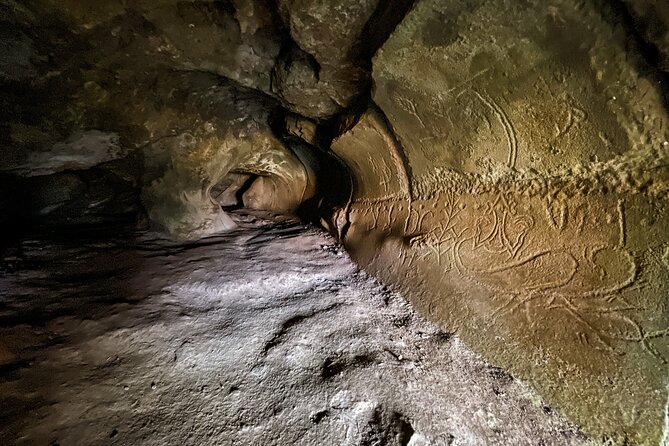
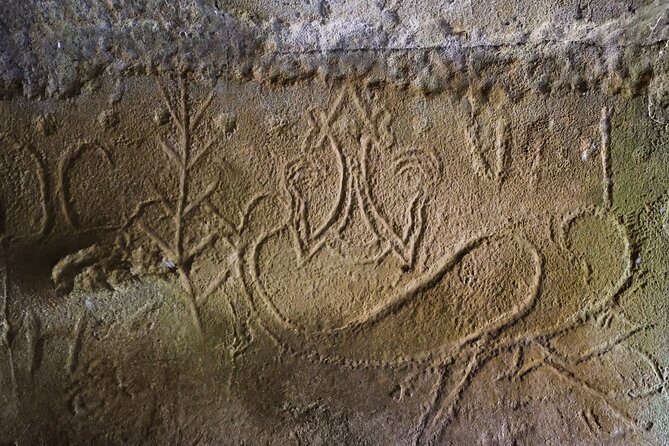
- Ana o Keke is the artistic highlight, with plant, bird, fish, canoe, and geometric carvings inside a lava tube.
- The private format keeps the day flexible, and the guide can adapt to your group’s needs and pace.
- Pua Katiki gives you wide views of both coastlines, from the highest point on the peninsula.
- Ahu Moai Tea Tea preserves about a dozen toppled moai, offering a different view of Rapa Nui sculpture.
- The tour is not suitable for cruise ship schedules, and a good level of physical fitness is required.
Why Pōike feels different from the usual Rapa Nui day
Most first visits to Easter Island focus on famous ahu platforms and rows of moai. Pōike offers something less polished and less predictable. Here, the interest comes from scattered ceremonial sites, old paths, volcanic formations, oral traditions, and carvings that are easy to miss without a guide.
The peninsula is also important in terms of age. Pua Katiki is the oldest volcano on Rapa Nui, and the area contains sites connected with burial, astronomy, ritual, sculpture, and local stories. You are not simply moving from one famous statue to another. You are following a wider record of how people used this part of the island.
The private setup matters. Your group is the only group on the activity, and an accredited local guide accompanies you. One Spanish-language review gives the guide high praise for being prepared for unexpected problems, sharing useful knowledge, and adapting to the people in the group. Since no guide’s name is provided, I would confirm the language and guide assignment when booking if that matters to you.
More things to do on Easter Island:
- From Hanga Roa: Rapa Nui Culture Sightseeing Tour
★ 4.6 · 307 reviews - From Hanga Roa: Easter Island Highlights 2-Day Tour
★ 4.3 · 205 reviews - Full Day Tour in Rapa Nui
★ 4.5 · 122 reviews
Ahu Mahatua and the three hills of Pōike
The day begins at Ahu Mahatua, a ceremonial center once used for cremation and burial rites. It is a fitting opening because it gives you a sense of Pōike as a ritual area, not just a scenic hiking route.
From here, the route follows the steep coast. Three distinct hills rise above the area: Ma’unga Parehe, Ma’unga Tea Tea, and Ma’unga Vai a Heva. Each has its own name and stories, and the changing ground makes the walk feel more like an archaeological route than a standard nature trail.
The first stop is planned for about 30 minutes. That may not sound long, but the day contains several stops of similar length, with a longer hour at Ana o Keke. The schedule leaves room for explanation without turning every location into a drawn-out lecture.
Take the word steep seriously. The tour information asks for strong physical fitness, and that requirement is more important here than the six-to-eight-hour duration alone suggests. You should be comfortable walking 12 kilometers over uneven ground and spending much of the day outdoors.
Maunga Parehe and Rapa Nui stories
Maunga Parehe is one of Pōike’s three named hills. At its summit, you find a small moai made from lapilli tuff, a volcanic material formed from compacted fragments.
The statue is not described as a large, dramatic figure like the famous moai at other sites. That is part of its appeal. You get a closer look at a smaller piece and a chance to consider the range of materials and sizes used by Rapa Nui sculptors.
This stop also connects the physical site with stories about ure a oho vehi and the aku aku spirits. Those names may mean little on a map, but they matter when a local guide explains how myth and place connect. I would treat this part of the day as an oral-history stop as much as an archaeological one.
Expect about 30 minutes here. The climb to a summit can make this portion feel more strenuous than the timing suggests, especially under strong sun. Bring a hat, use sun protection, and do not count only on the bottled water provided.
Ahu Kiri Reva and the excavated moai face
Ahu Kiri Reva presents three different construction stages. That detail gives the site a useful lesson in how ceremonial platforms changed over time. You can see the place not as one finished monument, but as a structure that was built and altered in separate phases.
Archaeological excavation in 2006 uncovered a remarkable moai face here. The discovery is linked to Nicolas Cauwe. Seeing a partially revealed or excavated feature can be especially valuable because it shows how much of Rapa Nui’s archaeological record remains below or beside what you first notice.
The stop lasts around 30 minutes. Do not expect a large complex with extensive visitor facilities. The attraction is the site itself and the explanation that puts its building phases and excavation into context.
A few more options to weigh up in Hanga Roa
- 2-Day Private Tour Easter Island Highlights Complete Discovery
★ 5.0 · 110 reviews - Private Full-Day Easter Island Highlights North and West
★ 5.0 · 84 reviews - Full Day Private Tour: Factory of the Moai the stone giants
★ 4.5 · 63 reviews - Private Easter Island Full-Day Tour
★ 5.0 · 61 reviews
Papa u’i hetu’u, where people watched the stars
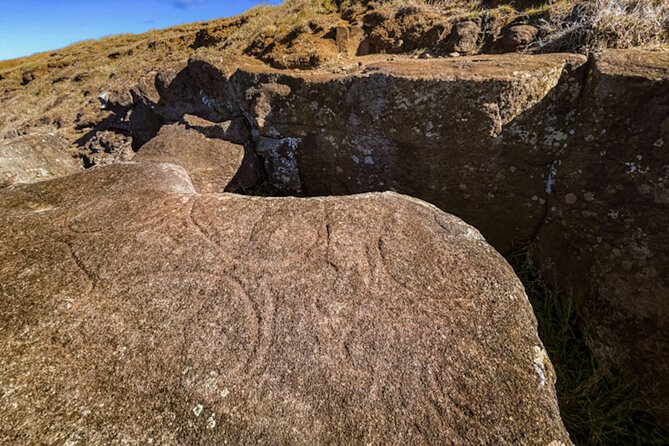
Papa u’i hetu’u translates as the flat lava flow from which the stars were observed. This is one of the most distinctive stops because it links astronomy with the volcanic ground beneath your feet.
The site has petroglyphs associated through oral tradition with Ma’ea Matariki, the Pleiades. That connection gives the carvings a place in the sky as well as on the rock. A guide is particularly useful here, since the meaning of a petroglyph is not always obvious to an untrained eye.
The planned visit lasts about 30 minutes. Look closely, but do not expect every mark to form an instantly readable picture. The value is in hearing how the site, the carvings, and the stars relate to Rapa Nui traditions.
Ana o Keke, the cave that rewards careful attention
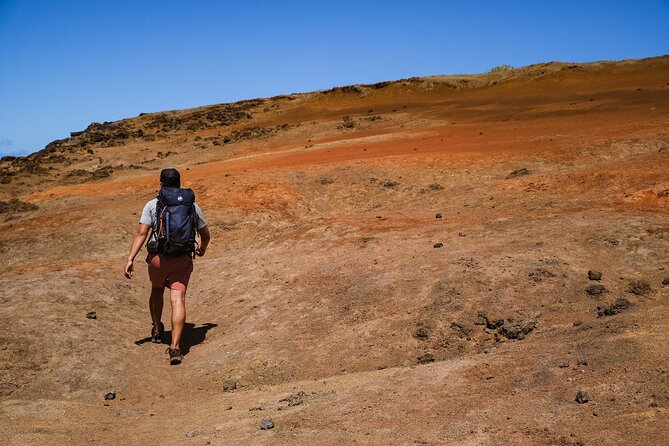
Ana o Keke is the longest stop, at about one hour, and it is likely to be the artistic center of the tour. The name is often translated as the cave of the virgins, and the lava tube carries a strong sense of history and mystery.
Inside, petroglyphs cover the inner surface of the lava tube. The designs include recognizable plants, birds, fish, and outrigger canoes, along with abstract geometric shapes. Some motifs are unique to this site, and the carvings form a planned composition rather than a random collection of marks.
This is where a good guide earns the private-tour price. You want time to look, ask questions, and understand what makes these carvings different from those at other Rapa Nui sites. A group tour may move on quickly, while a private guide can adjust the explanation to your interests.
The cave also changes the rhythm of the day. After walking beneath the sun and across open volcanic ground, you enter a more enclosed place where the carvings demand patience. Wear footwear that gives you confidence on uneven surfaces. The available information does not describe the cave’s exact access conditions, so anyone with mobility concerns should ask the operator before reserving.
Ahu Moai Tea Tea and the toppled statues
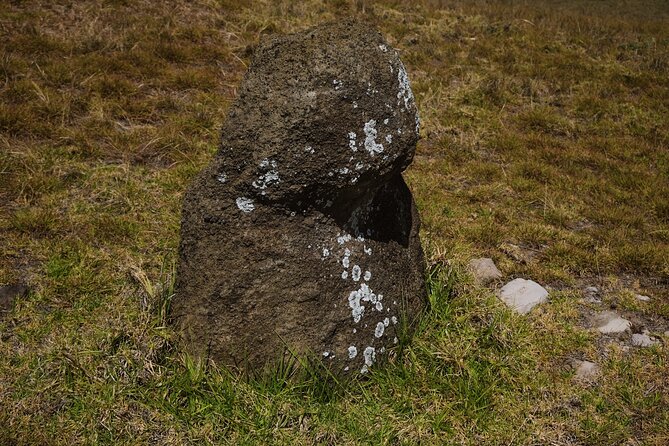
Ahu Moai Tea Tea contains about a dozen demolished moai carved from trachyte. These statues offer a different experience from the upright figures that appear in many photographs of Easter Island.
The word demolished is important. You are seeing moai in a fallen or damaged state, not a restored ceremonial display. That can feel less dramatic at first, but it gives you a more direct look at the island’s archaeological record and the changes that affected its ahu and statues.
The figures are described as well preserved, and their trachyte construction makes them notable. The stop lasts around 30 minutes. Your guide can help you notice the stone, scale, and condition of the statues rather than treating them as a quick photo stop.
Pua Katiki, the highest point on the peninsula
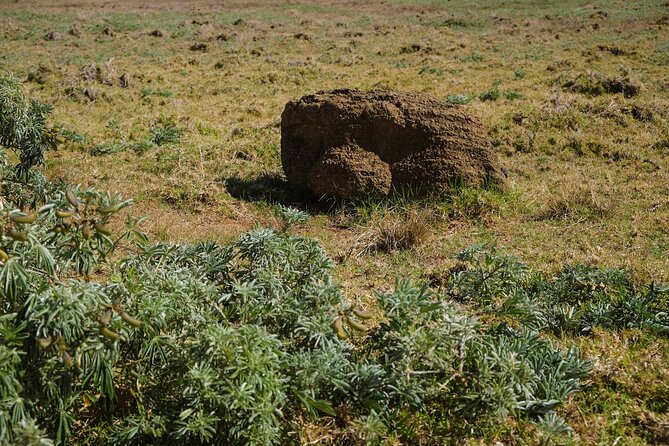
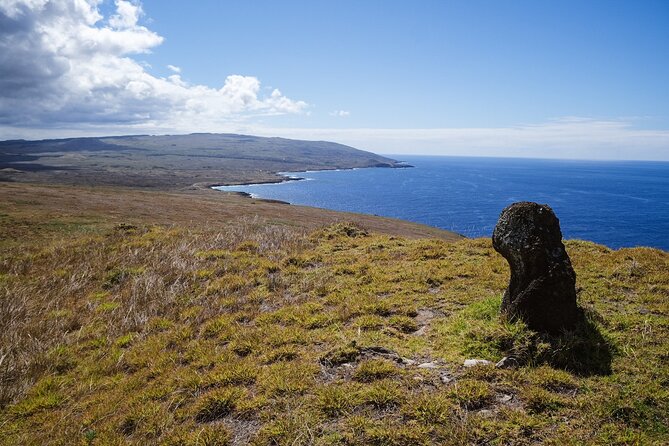
Pua Katiki is the highest point on Pōike and the oldest volcano on Rapa Nui. The reward is a broad view toward both the north and south coastlines.
This is the point where the day’s walking pays off most clearly. From above, the peninsula’s volcanic form and coastal position become easier to understand. The view also gives you a pause from close archaeological details and lets you see the wider setting of the sites you have visited.
The stop is scheduled for about 30 minutes. Sun and wind can be stronger on an exposed high point, so keep your protective clothing with you rather than leaving it in the vehicle. The tour includes bottled water, but you still need enough total water for the hike.
Maunga Vai a Heva and its stone face
The final listed site is Maunga Vai a Heva, another hill with archaeological importance. A small moai sits inside a cave here, adding one more connection between sculpture and the volcanic spaces of Pōike.
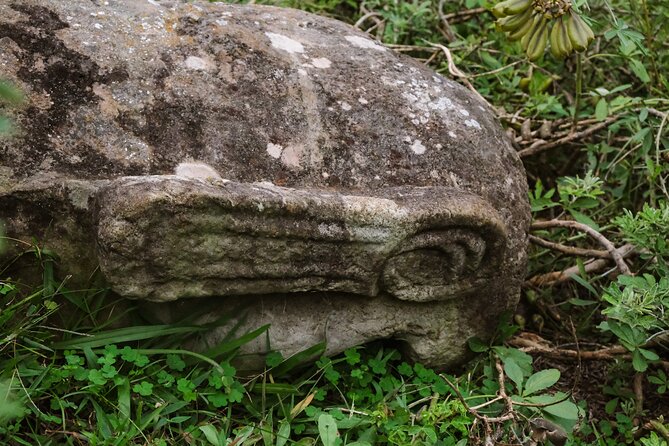
The hill takes its name from a large head carved into the rock. The head measures about three meters and has prominent eyes, a broad nose, and a natural hollow below that forms a mouth. That cavity may have been used to collect rainwater.
This is an unusually memorable detail because the feature combines carving with a practical use of natural rock. As with many places on this tour, the interest is not only in what you see, but in the questions the site raises about ceremony, water, and daily life.
The stop lasts about 30 minutes. By this stage, your legs may be tired, so the full-day schedule is worth keeping in mind when deciding if this tour suits you.
What the $200 price gets you
At $200 per person, this is not a budget excursion. The value depends heavily on your group size and what you want from a day on Rapa Nui.
You are paying for a private and personalized experience, an accredited local guide, hotel pickup and drop-off, an air-conditioned vehicle, and bottled water. Those inclusions remove several practical concerns, especially after a long hike. The vehicle also gives you a comfortable base before, between, or after walking sections of the route.
The cost is easier to justify for a couple, family, or small group that would otherwise need to arrange transport and a guide separately. Group discounts are offered, which may improve the per-person value for larger private parties.
Lunch is not included. Plan ahead and bring enough food for a full day, along with any extra water you need. The tour information specifically advises food and water, so do not assume the bottle provided will cover the entire 12-kilometer route.
Who should book this Pōike hike
I would choose this experience if you have already seen the main Rapa Nui sights or if you prefer archaeological places with fewer obvious structures and more interpretation. It suits people who enjoy walking, local stories, petroglyphs, and the connection between natural features and ceremonial use.
It also suits visitors who value privacy. Your guide can adapt explanations and pace to your group, a quality praised directly in the Spanish-language feedback. That flexibility may be especially useful if one person in your party needs more time at the carvings or wants extra explanation about the myths.
I would hesitate if you want a relaxed vehicle tour, dislike uneven outdoor walking, or have limited time on the island. The experience is not available for cruise ship visitors, and a 12-kilometer route is a poor match for anyone looking for a short shore excursion.
Wear sturdy footwear and long pants. Add sun protection and food to your day bag. The tour requires good weather, and if conditions force a cancellation, you can receive a new date or a full refund.
Final verdict: a strong choice for active history lovers
Book this Pōike tour if you want Easter Island beyond the famous postcard views. Its best moments are the carefully arranged petroglyphs at Ana o Keke, the star-watching site at Papa u’i hetu’u, the small moai and local stories at Maunga Parehe, and the wide view from Pua Katiki.
Skip it if the distance, terrain, or lack of included lunch sounds tiring rather than interesting. For fit visitors with a full day available, the combination of private guiding, hotel transport, unusual archaeology, and coastal views gives the $200 price a reasonable case, especially with a group discount.
FAQ
How long does the Pōike Peninsula tour last?
The tour lasts approximately six to eight hours.
How far is the hike?
The route covers about 12 kilometers.
What time does the tour start?
The stated start time is 9:00 a.m.
Is hotel pickup and drop-off included?
Yes. Hotel pickup and drop-off are included, along with an air-conditioned vehicle.
Is lunch included?
No. Lunch is not included, so you should bring enough food for the day.
What level of fitness is required?
A strong level of physical fitness is required. The tour includes a 12-kilometer hike and steep coastal and volcanic areas.
Can cruise ship visitors join this tour?
No. The experience is not available for cruise ship visitors.
Just added in Hanga Roa
- Volcanic Refuges: Excursion to Underground Civilization★ 4.7 · 8 reviews
- Volcanic Wonders and the Kingdom of the Birdman: Half Day★ 5.0 · 6 reviews
- Half Day Private Tour: Caves and Volcanic Refuges★ 4.0 · 14 reviews
- Easter Island Ancestral Dinner and Show with Transport★ 4.5 · 2 reviews
- 2 Day Small Group Tour in Moai Monuments and Historic Pathways★ 5.0 · 22 reviews
- Visit Rapa Nui in 4 days with 3 Tours and Accommodation included★ 4.0 · 2 reviews
- Tour to the Motus: Boat trip and snorkeling in Rapa Nui★ 5.0 · 8 reviews
- The birdman journey in Easter Island★ 5.0 · 1 review
Easter Island Tours, compared.
Two days of Full Day Tour of Rapa Nui + Sunrise in Tongariki
Read our review →
2-Day Private Tour Easter Island Highlights Complete Discovery
Read our review →
Private Tour: Full Day Easter Island Highlights
Read our review →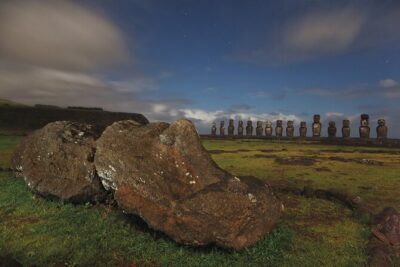
Browse the lists this tour appears in