
REVIEW · EASTER ISLAND TOURS
Private Full-Day Easter Island Highlights North and West
The moai are only half the story. This six-and-a-half-hour private tour connects Anakena Beach, ancient ahu platforms, volcanic quarries, and the birdman village at Orongo. I especially like the small group of up to eight and the way the route brings together archaeology, folklore, and modern Rapa Nui culture. Hotel pickup also makes the day easy to manage in Hanga Roa.
The best part is the guide-led context. Guides such as Sophia, Bruna, Marcus, Andres, and Merahy have been praised for making the sites come alive, answering questions, and adding useful stops when something catches their eye. The main trade-off is simple: lunch is not included, and the required national park ticket costs an additional $80 per person. Anakena Beach also gets only 35 minutes, so you will not have much time for swimming.
In This Review
- Key points at a glance
- Why this north and west route works
- Anakena Beach and Ahu Nau Nau
- Ahu Te Pito Kura and the fallen giant
- Puna Pau, the source of the red topknots
- Ahu Akivi and the unusual sea-facing statues
- Ahu Tahai and Hanga Roa’s nearby ceremonial world
- Rano Kau’s crater lake
- Orongo and the birdman competition
- The guides are the main value
- Timing, tickets, and what to bring
- Who will get the most from this tour
- Should you book the north and west tour?
- FAQ
- How long does the Easter Island north and west tour last?
- What time does the tour start?
- How many people can join the private tour?
- Is the national park ticket included?
- Is lunch included?
- Is the tour available in English?
- Can cruise ship passengers join this tour?
Key points at a glance
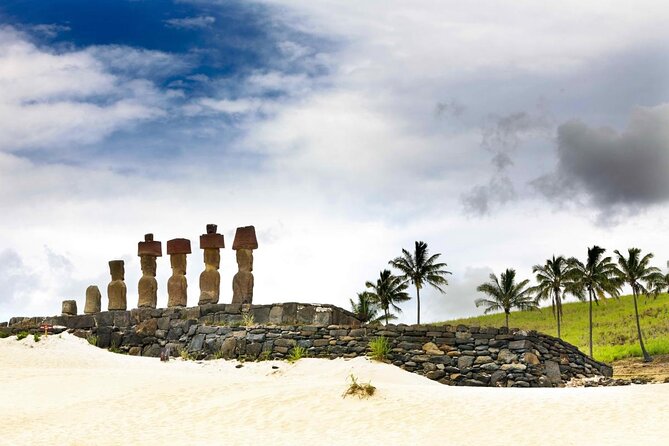
- Anakena combines beach and archaeology: See the island’s most attractive shore and the restored moai of Ahu Nau Nau.
- Orongo gives the strongest cultural story: Learn about the birdman competition beside Rano Kau’s dramatic crater.
- A private group keeps the day personal: Only your party participates, with a maximum group size of eight.
- The route covers a useful spread of sites: You visit ceremonial platforms, a pukao quarry, volcanoes, and coastal monuments in one outing.
- The national park ticket is extra: Buy the $80 ticket online beforehand or in Hanga Roa, and carry it throughout the day.
- The bilingual format affects the pace: The guide speaks in English and Spanish during the same tour.
Why this north and west route works
Easter Island, or Rapa Nui, is not a place where a quick photo stop tells you much. The statues are striking, but their meaning depends on knowing how they fit into village life, ceremony, competition, family groups, and the island’s volcanic setting.
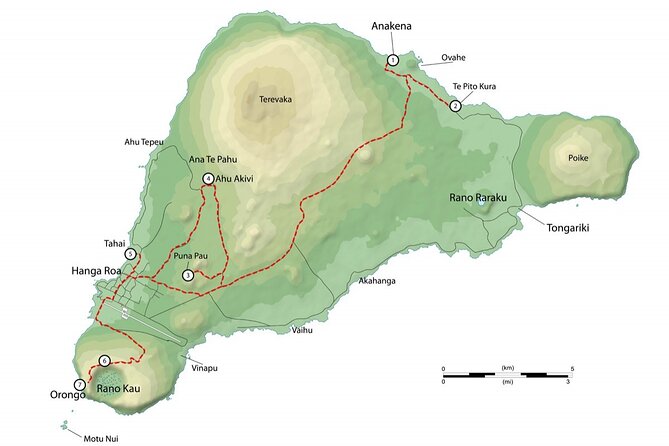
This tour gives you that wider frame. You move from Anakena, connected with ancient chiefly power, to Puna Pau, where the red stone topknots were made. You then see Ahu Akivi, Ahu Tahai, Rano Kau, and Orongo. The route has enough variety to keep the day from feeling like a string of similar stone platforms.
I also like the private format. A maximum of eight people means you can ask why a statue was placed in a certain position, how the topknots were made, or what the birdman contest involved without trying to catch a guide’s attention from the back of a large bus. Several guides have been praised for their humor, flexibility, and ability to explain more than the bare facts.
The tour begins at about 9:30 a.m. and lasts roughly 6 hours and 30 minutes. The listed stops total a little over three hours, leaving the rest for driving between sites, short pauses, and the guide’s explanations along the way. Traffic and transfer times can change the exact finish time.
More things to do on Easter Island:
- From Hanga Roa: Rapa Nui Culture Sightseeing Tour
★ 4.6 · 307 reviews - From Hanga Roa: Easter Island Highlights 2-Day Tour
★ 4.3 · 205 reviews - Full Day Tour in Rapa Nui
★ 4.5 · 122 reviews
Anakena Beach and Ahu Nau Nau
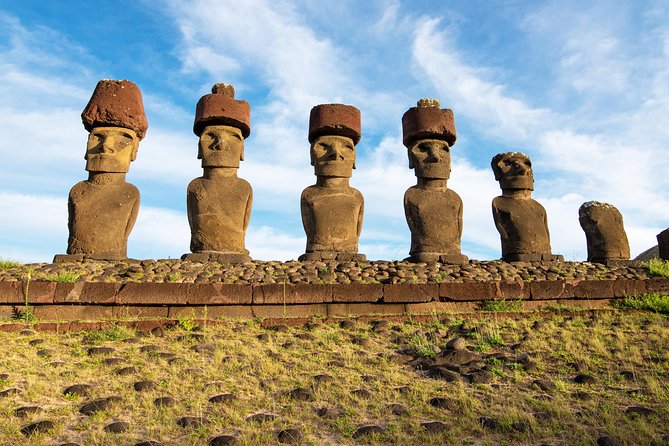
Anakena is the most beautiful beach on the route, but this is not mainly a beach outing. The ancient capital of Rapa Nui society was located here, and the sand frames one of the island’s most important ceremonial areas.
The restored moai at the ahu are the main reason to visit. They are among the best-preserved restored statues on the island, and some were buried in sand for centuries before being uncovered. That detail gives the site a physical sense of time: these are not simply old monuments left in place, but statues that disappeared, survived, and were brought back into view.
You have about 35 minutes here. That is enough for the archaeological explanation and photographs, but not enough for a relaxed swim, long beach walk, and careful visit all at once. If swimming matters to you, plan to return independently another time. The tour’s emphasis is the history of the area, not beach recreation.
This is a good first stop because it immediately broadens your idea of Easter Island. The island’s ceremonial centers were not all placed on bleak, isolated ground. Anakena links political power, ancestral monuments, and a pleasant coastal setting.
Ahu Te Pito Kura and the fallen giant
Ahu Te Pito Kura offers a different mood. Here you see the remains of the tallest moai ever successfully moved to an ahu, a statue that reached about 9.9 meters. It was toppled in ancient times and remains unrestored.
That unfinished condition matters. At Anakena, restoration helps you picture the monuments as they once appeared. At Te Pito Kura, the fallen statue makes the later collapse of the ahu more visible. You are looking at both the achievement of moving a huge stone figure and the evidence that the ceremonial system did not last forever.
The stop lasts about 25 minutes. Your guide can also point out a round magnetic rock nearby, associated with local stories about magical powers. Treat that part as folklore rather than a scientific claim, but do not dismiss it. Stories tied to particular stones and places help explain how the island’s sacred geography continues to work in the imagination.
Puna Pau, the source of the red topknots
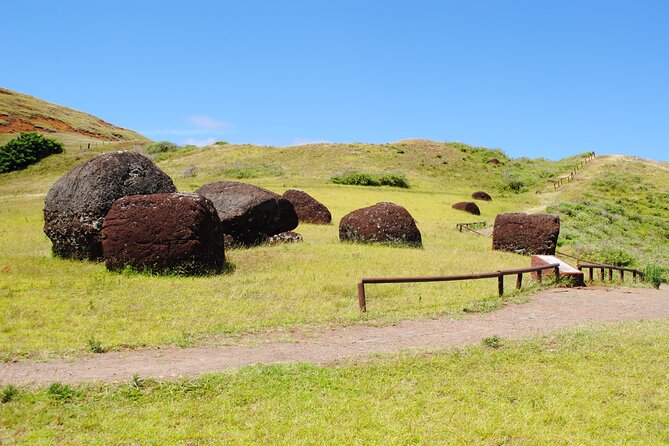
Puna Pau is a small volcano, and its importance is easy to miss if you only think of moai as carved bodies. This was the quarry for the red scoria used to make the statues’ pukao, or topknots. Every moai pukao came from this place.
The red stone creates a useful visual contrast with the darker volcanic rock used for many statues. More important, the site shows that the moai tradition required several separate stages of work: carving the statue, producing the topknot, transporting both, and placing them on an ahu.
You get around 20 minutes here. It is a short stop, but it adds a key piece to the puzzle. If you have already seen moai at other sites, Puna Pau helps you notice details above their heads rather than treating each statue as a single block of stone.
A few more options to weigh up in Hanga Roa
- 2-Day Private Tour Easter Island Highlights Complete Discovery
★ 5.0 · 110 reviews - Full Day Private Tour: Factory of the Moai the stone giants
★ 4.5 · 63 reviews - Private Easter Island Full-Day Tour
★ 5.0 · 61 reviews - Private Full-Day Easter Island Highlights South and East
★ 5.0 · 60 reviews
Ahu Akivi and the unusual sea-facing statues
Ahu Akivi is known for its seven moai, the only monument on the route whose statues look out toward the sea. That makes it one of the easiest places to compare with other ahu, where the relationship between the statues and the ocean feels different.
The visit lasts about 20 minutes. The short time works well here because the site has one clear idea to explain, the unusual orientation of the moai. Your guide can give the monument a place within the island’s wider ceremonial traditions rather than leaving you with a quick photograph and no context.
This is also a useful point in the day to ask questions. Guides praised in past tours, including Sophia and Bruna, were noted for answering questions and adding background about farming, local customs, and current life on the island. The private setup gives you a better chance to turn a general explanation into a conversation.
Ahu Tahai and Hanga Roa’s nearby ceremonial world
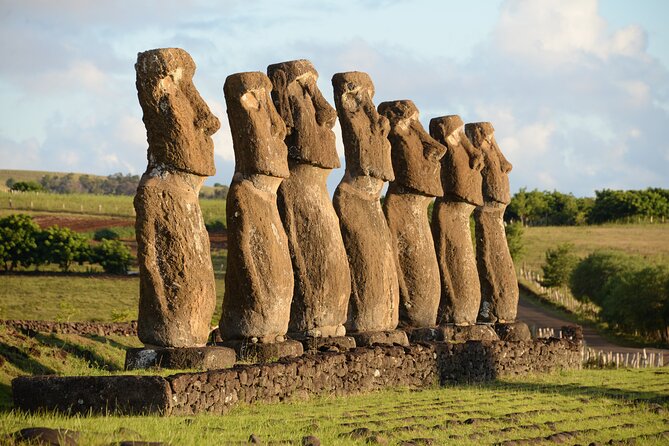
Ahu Tahai brings you close to Hanga Roa while still focusing on ancient village life. The area contains three ahu platforms, showing how ambitious and organized the people connected with this settlement were. A ramp leading into the ocean adds another practical detail to the site.
You have about 30 minutes here. The multiple platforms make it a good place to compare statue placement and ceremonial design. Instead of seeing one isolated monument, you can picture a wider community with work, movement, ritual, and access to the coast.
The site is especially useful if you are trying to understand how the moai related to living communities. These were not random statues scattered across an empty island. They were part of settlements and ceremonial centers, built by people with demanding social and engineering systems.
Rano Kau’s crater lake
Rano Kau is one of the strongest scenic stops. The volcano’s crater opens into a broad view, with a crater lake that served as an important source of drinking water in ancient times.
The tour allows about 20 minutes here. That is enough to take in the view and hear the explanation, though anyone who enjoys lingering at a dramatic viewpoint may want more time. The tight schedule is the price of fitting seven major stops into one day.
I like Rano Kau because it combines scenery with a practical question: how did people live on a remote island with limited resources? The crater was not just a pretty natural feature. Its water helped support life, and its high rim also leads directly to the next stop, Orongo.
Orongo and the birdman competition
Orongo is the most culturally distinctive stop on this route. This ceremonial stone village sits on the ridge of Rano Kau and is associated with the birdman competition. You also get a view back into the volcano’s crater from the village.
The visit lasts about 45 minutes, the longest scheduled stop. That extra time is well used. The birdman tradition is complex, and it deserves more than a single sentence between photo stops. Your guide can explain how the competition fit into political and religious life on Rapa Nui, along with the folklore surrounding it.
Past guides such as Merahy and Bruna have been praised for making this part especially engaging. Merahy was noted for combining clear historical explanation with a warm, playful manner, while Bruna was praised for connecting small roadside details to broader questions about farming and island life. Those qualities matter at Orongo, where the setting alone is impressive but the story gives it meaning.
If you want the most memorable teaching moment of the day, this may be it. The stone houses, crater rim, and birdman tradition create a direct link between place and belief. You are not simply looking at ruins. You are seeing a site chosen for its position, its views, and its role in a competition that shaped leadership.
The guides are the main value
At $280 per person, this is not a budget sightseeing drive. Add the $80 national park ticket, and the required cost becomes $360 per person before lunch. That price deserves a clear explanation.
You are paying for a private vehicle, hotel pickup and drop-off, a driver-guide, bottled water, and a small group that visits a wide selection of major sites. The strongest value comes from the guiding. A car ride between statues is easy to arrange, but understanding why the statues matter is much harder without someone who can connect the archaeology, oral traditions, and living culture.
The guide names associated with especially strong experiences include Neo, Andres, Marcus, Sophia, Merahy, Bruna, Elisa, Eliza, Ben, and Frank. You cannot choose a particular guide based on the information available, but the repeated praise for friendly, flexible, animated guiding is encouraging. One guide was even described as stopping when an interesting roadside detail led to a useful discussion.
The tour is bilingual, with the same guide explaining everything in English and Spanish. If you speak only one of those languages, the pace may be a little slower than on a single-language tour. That is worth knowing, though it also makes the experience workable for mixed-language groups.
Timing, tickets, and what to bring
Hotel pickup is included, with a scheduled start around 9:30 a.m. You should have your national park ticket ready before pickup. The ticket costs $80 per person, is valid for all tours and sites, and can be purchased online or in Hanga Roa’s town center.
Carry the ticket with you throughout the day. It is required for all visitors to Easter Island, and the tour price does not include it. Lunch is also not included, so plan accordingly using only the information available from your own accommodation or local plans. Do not expect the 35-minute Anakena stop to function as a full beach break and meal stop.
Children must be accompanied by an adult. Most people can take part, but the tour is not available to cruise ship passengers. That restriction matters because the 9:30 a.m. hotel pickup and six-and-a-half-hour schedule are designed for people staying on the island, not for a ship’s limited port call.
Free cancellation is available when you cancel at least 24 hours before the start time. Changes or cancellations made less than 24 hours ahead are not accepted for a refund.
Who will get the most from this tour
I would choose this tour if you want the north and west sights explained properly and prefer not to manage transport yourself. It suits couples, solo visitors, friends, and families who value conversation over a large coach and a fixed script.
It is also a strong choice for anyone who plans to add the corresponding south and east route. Together, the two outings cover the island’s main ceremonial and volcanic highlights. Several people have found that the same guide on both days made the experience feel more connected, so you can ask when booking if a repeat guide is possible, though it is not guaranteed.
I would think twice if your main goal is a long beach day, independent photography, or a very slow pace at each site. Seven stops in about six and a half hours means some visits are brief. You will see a lot, but you will not have unlimited time to wander.
Should you book the north and west tour?
Book it if you want a well-organized introduction to Easter Island with serious attention to context. The combination of Anakena, the great fallen moai at Te Pito Kura, Puna Pau’s red stone, Ahu Akivi, Ahu Tahai, Rano Kau, and Orongo gives you a strong sense of how the island’s monuments, resources, beliefs, and communities fit together.
The private group and hotel transport make the $280 price easier to justify, especially if you want to ask questions. Just budget for the separate $80 park ticket and lunch, and do not confuse the Anakena visit with a full beach outing.
FAQ
How long does the Easter Island north and west tour last?
The tour lasts approximately 6 hours and 30 minutes, including transfers between sites. The exact duration can change with traffic and the time spent traveling.
What time does the tour start?
The scheduled start time is 9:30 a.m., with hotel pickup included.
How many people can join the private tour?
The tour is private, so only your group participates. The experience is designed for a small group of up to eight people.
Is the national park ticket included?
No. Each person must buy a separate $80 national park ticket online beforehand or in Hanga Roa. The ticket is valid for all tours and sites, and you must carry it during the day.
Is lunch included?
No. Lunch is not included in the tour price.
Is the tour available in English?
Yes. Tours are bilingual and are conducted in English and Spanish by the same guide.
Can cruise ship passengers join this tour?
No. The tour is not available for cruise ship passengers.
Just added in Hanga Roa
- Volcanic Refuges: Excursion to Underground Civilization★ 4.7 · 8 reviews
- Volcanic Wonders and the Kingdom of the Birdman: Half Day★ 5.0 · 6 reviews
- Half Day Private Tour: Caves and Volcanic Refuges★ 4.0 · 14 reviews
- Easter Island Ancestral Dinner and Show with Transport★ 4.5 · 2 reviews
- 2 Day Small Group Tour in Moai Monuments and Historic Pathways★ 5.0 · 22 reviews
- Visit Rapa Nui in 4 days with 3 Tours and Accommodation included★ 4.0 · 2 reviews
- Tour to the Motus: Boat trip and snorkeling in Rapa Nui★ 5.0 · 8 reviews
- The birdman journey in Easter Island★ 5.0 · 1 review
Easter Island Tours, compared.
Two days of Full Day Tour of Rapa Nui + Sunrise in Tongariki
Read our review →
2-Day Private Tour Easter Island Highlights Complete Discovery
Read our review →
Private Tour: Full Day Easter Island Highlights
Read our review →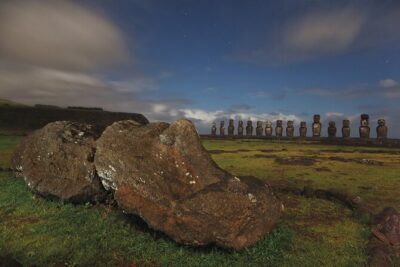
Browse the lists this tour appears in