
REVIEW · EASTER ISLAND TOURS
2 Day Private Tour: Easter Island’s Cultural Heritage
Rapa Nui rewards a careful guide. This two-day private tour packs the island’s major archaeological sites, volcanic scenery, and cultural stories into a practical route from Hanga Roa. I especially like the personal attention of a private vehicle and the chance to visit places such as Rano Raraku and Orongo with context, not just a quick photo stop. The main consideration is the pace: you cover a great deal in two days, and lunch is not included, so some stops can feel brisk.
I also like the simple logistics. Hotel pickup and drop-off, bottled water, an air-conditioned vehicle, and an accredited local guide remove much of the daily guesswork. Guides Joaquin and Juan Soler Bolt receive especially warm praise for their stories, kindness, photography help, and ability to adjust the day for families. One caution: check your final schedule carefully, since a few guests found the second day ended earlier than expected.
In This Review
- Key points before you book
- Is $320 a fair price for two full days?
- Day 1: Anakena, the island’s northern ceremonial heart
- Te Pito Kura and the biggest fallen moai
- Puna Pau and Ahu Akivi, headdresses and astronomy
- Tahai at the best end-of-day viewpoint
- Day 2: Vinapu and the island’s architectural puzzles
- Ahu Vaihu reveals the village behind the statues
- Akahanga, oral tradition, and toppled moai
- Rano Raraku, where the moai began
- Ahu Tongariki closes the two-day story
- What the private format adds
- Who should book this Rapa Nui tour?
- Should you book it?
- FAQ
- How long is the tour?
- What is included in the price?
- Is lunch included?
- Is the national park fee included?
- Is this a group tour?
- Can cruise ship passengers book this tour?
- Can most people participate?
- What happens if bad weather cancels the tour?
Key points before you book
- Seven major moai at Ahu Akivi: See the unusual inland platform where seven statues face toward the sea.
- Rano Raraku is the essential stop: Walk among unfinished moai still attached to the volcanic quarry.
- Ahu Tongariki brings the grand finale: Fifteen restored statues line the island’s largest ceremonial platform.
- Private guiding changes the experience: Joaquin and Juan Soler Bolt are praised for clear explanations, local stories, photo help, and flexible pacing.
- The two days cover almost the whole island: You visit beaches, crater rims, ceremonial platforms, villages, quarries, and petroglyphs.
- Budget for extras: The national park fee and both days’ lunches are not included in the $320 price.
Is $320 a fair price for two full days?
At $320 per person, this tour is not a bargain-basement outing, but it can be good value if you want to see nearly all of Rapa Nui’s main sites without arranging transport yourself. The price includes private transportation, hotel pickup and return, bottled water, and a guide devoted only to your party.
That private format matters on Easter Island. You are not tied to a large bus group, and your guide can answer follow-up questions, help with photographs, or make small changes for a child or an older family member. Joaquin has been praised for bringing water and snacks, helping a 71-year-old visitor when needed, and offering care without being patronizing.
You still need to pay the national park fee, and lunch is separate. Allow time and money for meals during the day. Some schedules may finish earlier than the stated full-day impression, particularly on Day 2, so ask for the expected return time when you confirm.
The tour is normally booked well ahead, with an average booking lead time of about 110 days. That is useful planning advice for a remote destination with limited tour capacity. Confirmation is sent within 48 hours, subject to availability.
More history tours in Hanga Roa:
- 2 Day Small Group Tour in Moai Monuments and Historic Pathways
★ 5.0 · 22 reviews - Easter Island Private Tour: Historical Journey North & West
★ 5.0 · 2 reviews - Santiago: Guided Walking Tour of the Historical Old Town
★ 4.8 · 459 reviews
Day 1: Anakena, the island’s northern ceremonial heart
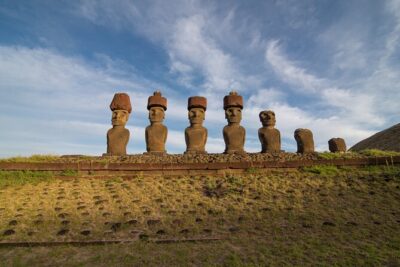
The first day begins at 9:00 a.m. with hotel pickup in Hanga Roa. The route starts at Anakena Beach, a good introduction because Rapa Nui’s story here begins with settlement and tradition, not simply scenery.
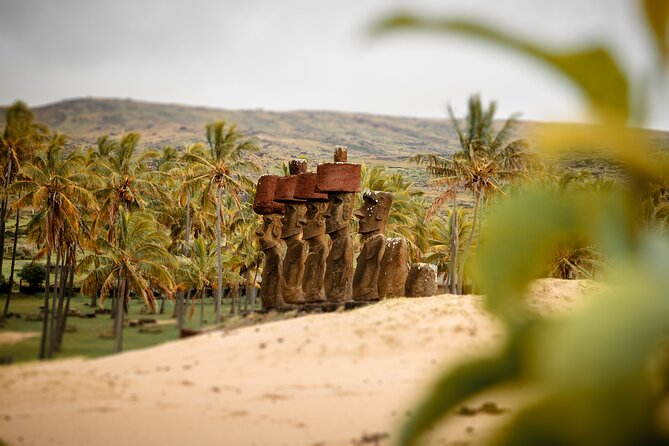
Anakena is linked by legend to Hotu Matu’a, the first king, who is said to have landed here and founded the first settlement. The area later became important to the Miru tribe and developed into a large population center with homes, ceremonial platforms, and other remains dating to around 1200 AD.
You have about 45 minutes here. Focus on Ahu Nau Nau, whose seven moai are unusually well preserved. Sand covered the statues after they fell, shielding much of their carving from weathering until the complex was restored in 1978. Nearby Ahu Ature Huki has a single moai.
The beach itself gives the day a welcome change of mood. After several archaeological stops, the palms and sand make it easier to picture why this was an attractive place for settlement. Still, 45 minutes is enough for a focused visit, not a long beach outing.
Te Pito Kura and the biggest fallen moai
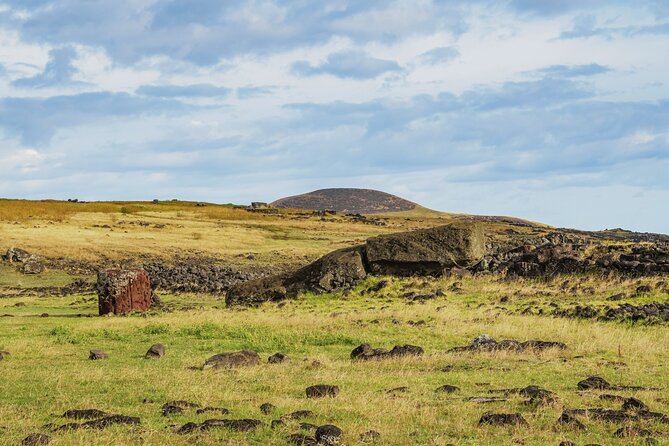
At Ahu Te Pito Kura, you see Paro, the largest moai ever raised on an ahu. The statue measures about 10 meters and weighs more than 80 tons. It lies where it fell nearly two centuries ago, with its huge pukao resting in front.
The scale is easier to appreciate here because the statue is down rather than upright. You can study the size of the body and the red stone headdress without the visual effect of a restored platform. Tradition says a widow commissioned Paro in memory of her husband, and that it was among the last statues toppled, around 1838.
Nearby is the round stone called Te Pito Kura. It has long been linked with magnetic and supernatural properties, and with the idea of mana, or spiritual force. Your guide can help separate oral tradition from what is known through archaeology, which is exactly where a private tour earns its keep.
Puna Pau and Ahu Akivi, headdresses and astronomy
The extinct volcano of Puna Pau supplied the red scoria used for pukao, the cylindrical headdresses placed on many moai. The stone was softer than the volcanic tuff used for the statues, making it suitable for carving not only pukao but also containers, ornamental blocks, and other objects.
The practical problem was transport. Some headdresses traveled more than 10 kilometers to ceremonial platforms. Excavation has revealed part of the original route, giving you a clearer sense of the work involved. Puna Pau is quieter and more enclosed than Rano Raraku, and its history feels tied to a specialized, sacred craft.
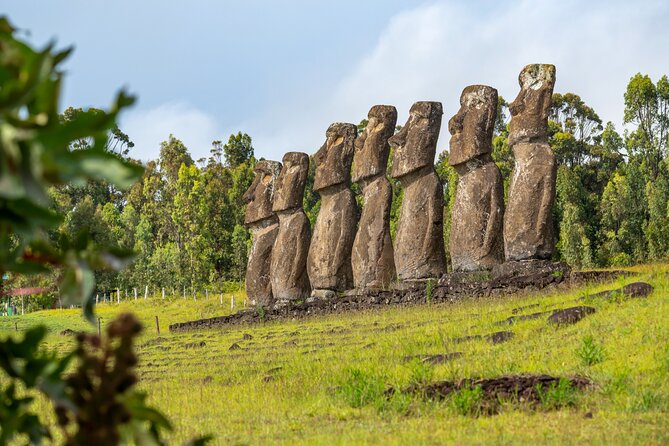
At Ahu Akivi, seven carefully carved moai face toward the sea from an inland platform. That position is unusual on Rapa Nui, where many ahu sit along the coast and face inland toward former settlements. The platform is also associated with the powerful Miru clan and with theories that the statues represent the island’s first explorers or ancient kings.
The seven statues were transported roughly 15 kilometers from Rano Raraku. Their placement and the site’s astronomical alignment make this a thoughtful stop for anyone interested in how ceremony, politics, and the sky shaped Rapa Nui society.
More things to do on Easter Island:
- From Hanga Roa: Rapa Nui Culture Sightseeing Tour
★ 4.6 · 307 reviews - From Hanga Roa: Easter Island Highlights 2-Day Tour
★ 4.3 · 205 reviews - Full Day Tour in Rapa Nui
★ 4.5 · 122 reviews - 2-Day Private Tour Easter Island Highlights Complete Discovery
★ 5.0 · 110 reviews
Tahai at the best end-of-day viewpoint
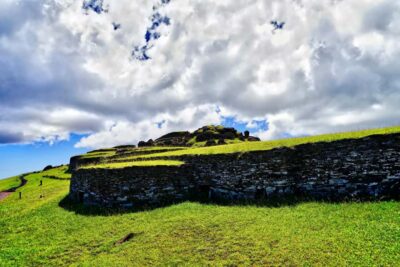
Ahu Tahai is both an archaeological center and a useful place to understand daily life around an ahu. The Marama and Miru clans occupied this area, and restoration work revealed a settlement where perhaps 75 to 200 people lived, using caves and rocky shelters as part of their homes.
Three platforms form the core of the complex. Look for the stone ramp between Ahu Vai Uri and Ahu Tahai, thought to have helped lower fishing boats from the upper level to the shore. It is a small detail, but it shows the practical side of a society often reduced to its giant statues.
The tour then heads to Rano Kau, a huge crater about 1.5 kilometers across. Its lake provided drinking water, and the crater contains one of the island’s largest reserves of native plant life. The view from the rim is a fine counterpoint to the stonework seen earlier in the day.
At Orongo, you learn about the tangata manu, or birdman, competition. Representatives of rival clans descended the cliffs, swam to Motu Nui, and waited for the first manutara egg. The winner’s representative became birdman for the season, gaining rights and privileges for his clan.
Orongo contains more than 1,700 petroglyphs, the island’s greatest concentration of rock art. Plan on an hour here, since the site requires time for both the crater view and the ceremonial village. The ground and cliffs make sensible shoes useful, though the tour data says most people can participate.
Day 2: Vinapu and the island’s architectural puzzles
Day 2 begins again at 9:00 a.m. at Ahu Vinapu, where the stonework attracts as much attention as the toppled statues. One wall uses carefully fitted blocks that have prompted comparisons with Inca construction in South America.
That resemblance has led to theories of contact across the Pacific, but the site is valuable even without accepting those theories. The masonry shows how precisely Rapa Nui builders could shape and place stone. Vinapu II is older and includes scattered moai plus a distinctive red scoria column that may once have represented a female figure.
A second stop in the same general area includes Moai a Umi, a rare statue carved from red rock. The visit also reaches Hanga Poukura, where rough lava formations, buried statues arranged in a line, and a carefully built ahu create one of the more unusual settings on the route.
The description gives this stop 40 minutes, but the actual sightseeing time may depend on access and how much you discuss the competing interpretations. This is a good place to ask your guide about female representations, statue materials, and how much of the site is supported by evidence rather than later legend.
Ahu Vaihu reveals the village behind the statues
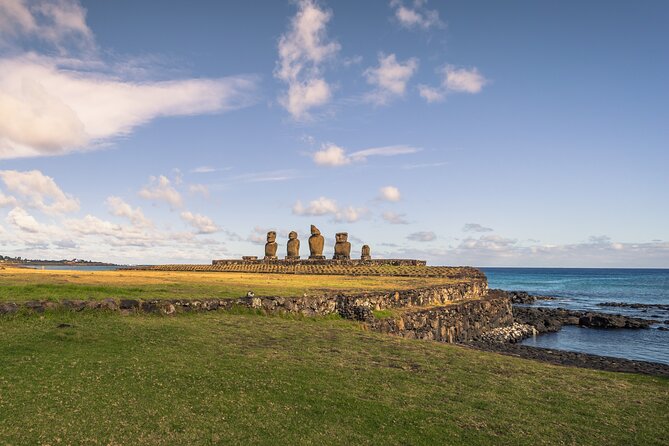
At Ahu Vaihu, the emphasis shifts from monumental sculpture to ordinary settlement. Reconstructed features include the foundations of hare paenga, homes with canoe-shaped stone outlines, along with umu pae stone ovens.
This stop helps you picture the people who maintained the ceremonial centers. The moai were not isolated objects. They belonged to communities with homes, food preparation areas, clan structures, and religious obligations.
You have about 40 minutes. I would use this time to ask your guide to connect the village layout with the ahu nearby. That sort of conversation is easier in a private group than in a large party moving on a fixed script.
Akahanga, oral tradition, and toppled moai
Ahu Akahanga was once one of the island’s largest villages. Its 18-meter platform holds 13 toppled moai, along with fallen pukao, a crematorium, and a small cave.
Oral tradition identifies the area with the burial of Hotu Matu’a, though the story includes several versions and legends. One concerns the discovery of the king’s skull. The site also has a connection with solstice sunsets and sunrises, and with the burial place of the king’s sister.
The planned visit lasts about 90 minutes, making Akahanga one of Day 2’s more substantial stops. That is welcome because the toppled statues require imagination. There is no polished row here. You are looking at a damaged ceremonial center and trying to understand the social changes that left these enormous figures on the ground.
Rano Raraku, where the moai began
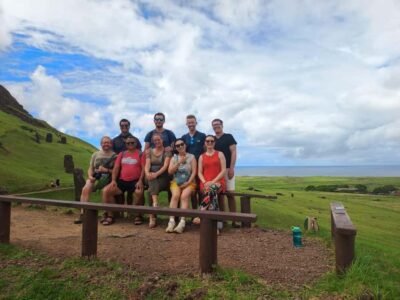
Rano Raraku is the tour’s essential archaeological stop. This volcanic quarry supplied the tuff used for almost 1,000 moai across Rapa Nui. The southern slope still contains unfinished statues, empty carving niches, and rows of heads and bodies in different stages of work.
The site changes your understanding of the statues. At the ahu, you see finished figures as symbols of ancestors and authority. At Rano Raraku, you see the production process. Some moai remain attached to the mountain, as if the sculptors simply walked away.
Allow 90 minutes here. That sounds generous, but you will want it. The quarry has uneven ground and uphill sections, so take your time and listen to your guide’s route advice. The tour provides bottled water, but carrying it with you is sensible.
This is also the stop where a private guide can make a real difference. A good explanation connects the quarry to Puna Pau, the later transport routes, the ceremonial platforms, and the political power needed to organize such labor. Joaquin is praised for explaining the sites in detail while also helping with photographs, including timing visits for better light.
Ahu Tongariki closes the two-day story
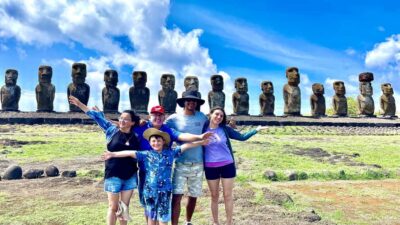
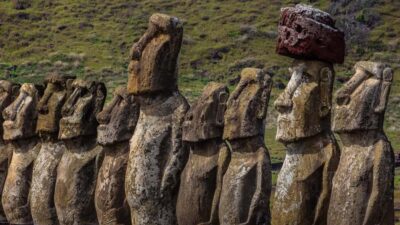
The final major stop is Ahu Tongariki, the largest ceremonial platform on Rapa Nui. Fifteen moai line an altar about 100 meters long, creating the island’s most commanding view of restored ancestral sculpture.
Tongariki is thought to date back to around 900 AD and served as a major political and religious center. Each statue has its own shape, size, and expression. Together they show how the carved style changed over time while preserving the idea of ancestors protecting the community.
Restoration returned the platform and statues to something close to their former visual power. That does not erase the site’s damage or history. Instead, it lets you see the scale of the original achievement and understand how much work was required to document, move, and reassemble the fallen stones.
Plan on about an hour. If the schedule is running late, ask how much time remains before you arrive. Some visitors felt Day 2 ended around 2:00 p.m. and would have preferred closer to 3:00 p.m. The published visit durations add up to a full morning and early afternoon before driving and meal time, so expectations matter.
What the private format adds
The strongest feature here is not just the list of sites. It is the ability to spend time on the questions that interest you. Guides can explain clan politics, restoration, oral tradition, astronomy, carving, or modern Rapa Nui life without forcing every group member through the same conversation.
Joaquin is repeatedly praised for warmth, clear English, flexibility, and local insight. One family with a toddler found him willing to adjust the itinerary. Another family appreciated his planning around lighting for photographs and his skill at avoiding crowded moments.
Juan Soler Bolt is also praised for knowing when to visit sites and for his calm, helpful manner. Guide assignments can vary, so you should not assume a specific person unless the provider confirms it. The common thread is attentive guiding rather than a detached audio-tour style.
Hotel pickup and drop-off are useful on an island where every transfer takes time. The air-conditioned vehicle is especially welcome after exposed walks at the crater rims and quarry. Bottled water is included, while lunch is your responsibility. Guides may suggest local places to eat, but the meal itself is not part of the price.
Who should book this Rapa Nui tour?
I would choose this tour if you have only two days on Easter Island and want the major sites handled in a logical order. It suits families, couples, solo visitors, and older adults who value a private vehicle and help at uneven archaeological sites.
It is also a good fit if you want cultural explanation rather than a checklist of statues. The itinerary includes the island’s major moai centers, but it also makes room for village remains, ceremonial traditions, petroglyphs, solstice alignments, volcanic resources, and competing ideas about outside contact.
You may want something else if you prefer long independent walks, unhurried beach time, or a later start. The 9:00 a.m. departure is fixed, lunch is extra, and the two-day plan is ambitious. Ask for the expected finishing time for each day before you commit.
Free cancellation is available up to 24 hours before the start time. Changes made within 24 hours are not accepted, and poor weather can lead to a new date or a full refund.
Should you book it?
Book this tour if efficient coverage and personal guiding matter most. For $320 per person, you get a private, two-day route through Rapa Nui’s defining sites, with transport and a guide who can turn stones into a human story.
Before booking, confirm the guide, national park fee, meal plan, and expected return time on Day 2. If those details suit you, this is a strong way to see the island’s essential places without sacrificing the questions and conversations that make Rapa Nui memorable.
FAQ
How long is the tour?
The experience lasts approximately two days, with both days starting at 9:00 a.m.
What is included in the price?
The price includes a private personalized experience, an accredited local guide, hotel pickup and drop-off, bottled water, and transport in an air-conditioned vehicle.
Is lunch included?
No. Lunch is not included, so you should budget separately for meals during the tour.
Is the national park fee included?
No. The national park fee is not included in the tour price.
Is this a group tour?
No. This is a private activity, so only your own group participates.
Can cruise ship passengers book this tour?
No. The experience is listed as unavailable for cruise ship passengers.
Can most people participate?
Yes. The tour information states that most people can participate. Some archaeological sites include uneven ground, crater views, and exposed areas, so ask the provider about your specific needs.
What happens if bad weather cancels the tour?
If poor weather causes cancellation, you will be offered another date or a full refund. You can also cancel for a full refund if you do so at least 24 hours before the start time.
Just added in Hanga Roa
- Volcanic Refuges: Excursion to Underground Civilization★ 4.7 · 8 reviews
- Volcanic Wonders and the Kingdom of the Birdman: Half Day★ 5.0 · 6 reviews
- Half Day Private Tour: Caves and Volcanic Refuges★ 4.0 · 14 reviews
- Easter Island Ancestral Dinner and Show with Transport★ 4.5 · 2 reviews
- 2 Day Small Group Tour in Moai Monuments and Historic Pathways★ 5.0 · 22 reviews
- Visit Rapa Nui in 4 days with 3 Tours and Accommodation included★ 4.0 · 2 reviews
- The Route of Hotu Matua Full-Day Tour from Hanga Roa★ 5.0 · 1 review
- Tour to the Motus: Boat trip and snorkeling in Rapa Nui★ 5.0 · 8 reviews
Easter Island Tours, compared.
Two days of Full Day Tour of Rapa Nui + Sunrise in Tongariki
Read our review →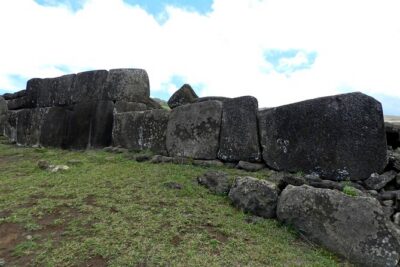
2-Day Private Tour Easter Island Highlights Complete Discovery
Read our review →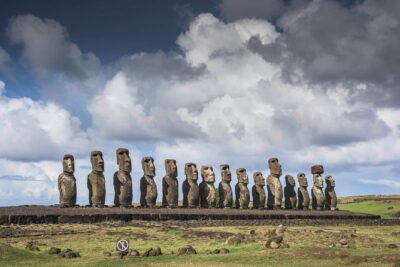
Private Tour: Full Day Easter Island Highlights
Read our review →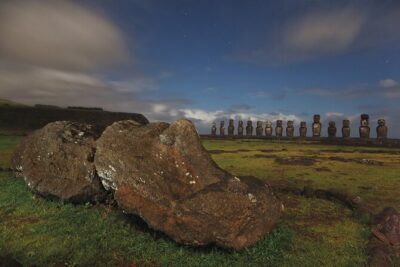
Browse the lists this tour appears in