
REVIEW · EASTER ISLAND TOURS
Rano Kau: Trek Around the Crater Rim
Volcano views with a cultural twist. This private half-day outing combines a walk around Rano Kau with Orongo and Ahu Vinapu, giving you both dramatic scenery and clues to how Rapa Nui communities used volcanic land. I especially like the chance to see the crater from changing angles and elevations, and the inclusion of private transport with a native, certified guide. The main drawback is the extra $100 National Park ticket, which is mandatory and sits on top of the $169 tour price.
The route is more than a quick viewpoint stop. With a guide, you may go beyond the most restricted viewing areas and walk almost around the crater, as one especially enthusiastic participant described. That can make the four-hour visit feel far more personal. Still, the exact walking route and pace are not specified, so you should ask about them if you want a serious hike rather than a guided outing with several stops.
In This Review
- Key points to know before booking
- Why Rano Kau is worth four hours
- Walking the crater rim from different angles
- Stop 1: Rano Kau and its reed-filled lagoon
- Stop 2: Orongo and the ceremonial setting
- Stop 3: Ahu Vinapu adds stonework and contrast
- What the private format changes
- Is $169 a fair price?
- Who will enjoy this Rapa Nui outing most?
- Booking, timing, and cancellation details
- My verdict: book it for the crater, not just the checklist
- FAQ
- How long is the Rano Kau tour?
- What time does the tour start?
- Is transportation included?
- Is the National Park ticket included?
- Is this a private tour?
- What is included in the tour price?
- Can I cancel for a full refund?
Key points to know before booking
- Rano Kau’s crater is more than 1.5 kilometers across, with a lagoon and floating reed islands inside.
- The private format keeps the day flexible, since only your group participates and transport is included.
- The route may go much farther than a standard lookout, with views from different angles and elevations around the rim.
- Orongo adds cultural meaning, linking the volcanic setting to one of Rapa Nui’s important ceremonial places.
- Ahu Vinapu gives the outing a second archaeological focus, rather than making the tour only about scenery.
- Budget $269 per person before any group discount, counting the $169 tour and the required $100 park ticket.
Why Rano Kau is worth four hours
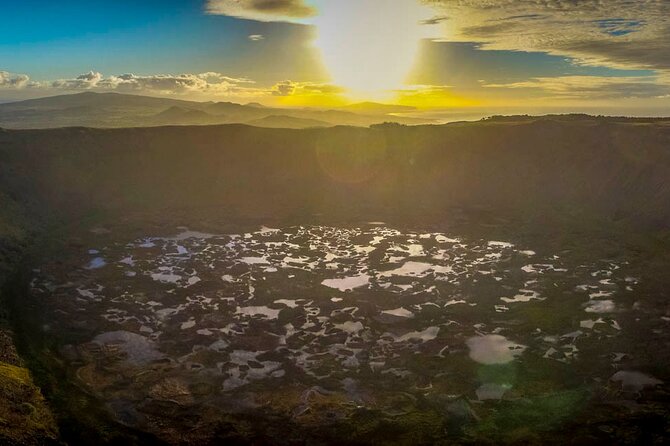
Rano Kau is one of Rapa Nui’s three extinct volcanoes. Its broad crater is the star of the outing, but the best part is not simply seeing a large hole in the ground. The crater contains a lagoon where moisture gathers, creating conditions that support plant growth and cultivation.
Inside, reed islands break up the water and give the crater an unusual appearance. The setting can feel strangely distant from the rest of Easter Island, almost like a contained world inside the volcano. The view is powerful because you are looking both across a huge natural bowl and down into a place shaped by water, plants, and human use.
The vegetation is another reason to take the walk slowly. Native plants and edible species, including bananas and tubers, point to the ways people once worked with the island’s conditions. The crater was not just scenery. Its damp interior offered a useful microclimate in an island environment where growing food could be difficult.
Your guide can help connect those details to the manavai, an old cultivation method using circular planting holes protected by stone walls. The form may have been inspired by volcanic craters such as Rano Kau. That idea gives the walk more weight. You are not only looking at a volcano. You are seeing a natural feature that may have influenced practical farming methods.
More Hiking Tours in Easter Island:
- Poike: Full Day Hike
★ 5.0 · 4 reviews - Easter Island 2 Half Days and 2 Full Days Private Trekking Tour
★ 5.0 · 3 reviews - Miru: The North Coast Full Day Hike
★ 5.0 · 2 reviews
Walking the crater rim from different angles
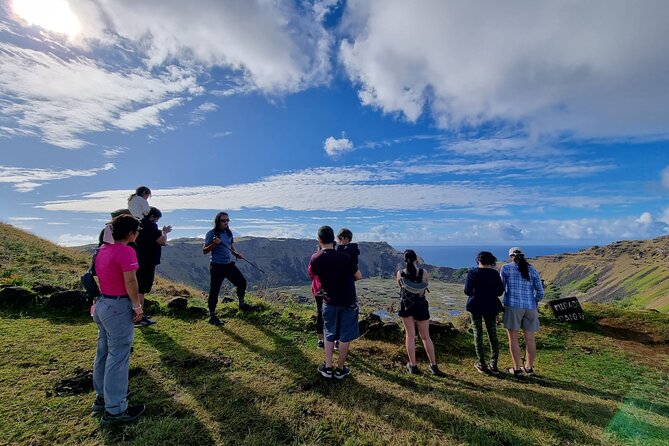
The tour summary describes a trek along the edge of Rano Kau, but the most useful detail is the possibility of going beyond the usual restricted areas. A guide may lead you farther along the rim, with the crater changing shape as you gain or lose height.
That variation matters. A single overlook gives you one postcard view. A longer route lets you notice how the crater walls curve, how the lagoon sits inside the bowl, and how the reed islands alter the color and texture of the water. From one point, the crater may feel immense. From another, the islets and lagoon may draw your eye inward.
The route is described as lasting about four hours, including Orongo and Ahu Vinapu. You should therefore expect a substantial portion of the morning to involve driving or stopping at the other sites, not four full hours of continuous walking. The word trek suggests more than a short stroll, but the available details do not state the distance, elevation gain, or trail conditions.
That is the one area where I would ask a direct question before booking. Find out how much time is spent on foot at Rano Kau, how close the vehicle gets, and whether the route follows the rim for most of the visit. This matters if you want a proper hike, or if you need to plan around your own pace.
The tour begins at 9:30 am. A morning start should give the outing a clear shape: pickup, the crater walk, then the additional sites before the tour ends roughly four hours later. Since private transportation is included, you are not left organizing separate rides between the stops.
Stop 1: Rano Kau and its reed-filled lagoon
Rano Kau is the main reason to book. The crater measures more than 1.5 kilometers across, so you get a sense of scale immediately. Looking into it from the rim, you see a large lagoon rather than a dry volcanic pit.
The reed islands are the feature that makes the view unusual. They sit across the water in scattered patches, creating a scene that seems out of place on a remote Pacific island. It is a strong example of how Rapa Nui can surprise you. The famous stone figures are only part of the island’s appeal. Here, water, volcanic rock, and plant life create the drama.
I also like that the tour treats the crater as a living setting with practical value. Moisture collects inside, and that damp air supports a range of native vegetation. The mention of bananas, tubers, and other edible plants gives you something specific to look for instead of leaving you with a vague nature talk.
The crater also helps explain manavai cultivation. These circular garden areas, enclosed by stone walls, protected plants and helped people make use of the island’s conditions. Seeing the crater before hearing about this system can make the explanation easier to understand. The connection between a natural bowl and a human-made growing method is one of the outing’s strongest educational points.
The highlight comes near the end of the route, when the crater opens toward the three main islets of Rapa Nui. The combination of the crater, the ocean, and the islets gives the final viewpoint a grand scale. Bring your attention to the horizon as well as the lagoon. The attraction is the way these features appear together.
Stop 2: Orongo and the ceremonial setting
Orongo is the second stop, and it changes the mood of the morning. Rano Kau shows you volcanic geography and cultivation. Orongo brings you into the ceremonial side of Rapa Nui.
The information provided does not specify exactly how long you stay at Orongo or which parts your guide visits. What is clear is that it forms part of the same route, allowing you to connect the crater setting with an important cultural site rather than treating the volcano as an isolated natural attraction.
That pairing is useful. Rano Kau supplies the physical setting, while Orongo helps show how people attached meaning to it. Your guide’s role matters here. A native and certified guide can place the site within Rapa Nui culture in a way that a quick self-guided stop may not.
Because this is a private tour, you can ask for more explanation at Orongo if the cultural side interests you. You can also ask the guide to keep the visit shorter if the crater walk is your main priority. The private format is not a guarantee of unlimited flexibility, but it gives your group a better chance to shape the conversation and pace.
More things to do on Easter Island:
- From Hanga Roa: Rapa Nui Culture Sightseeing Tour
★ 4.6 · 307 reviews - From Hanga Roa: Easter Island Highlights 2-Day Tour
★ 4.3 · 205 reviews - From Hanga Roa: Easter Island Sightseeing Full Day Tour
★ 4.5 · 189 reviews - Two days of Full Day Tour of Rapa Nui + Sunrise in Tongariki
★ 4.5 · 132 reviews
Stop 3: Ahu Vinapu adds stonework and contrast
Ahu Vinapu is the final listed stop. Its inclusion broadens the outing again, moving from a volcanic crater and ceremonial setting to an ahu, one of Rapa Nui’s stone platforms.
The supplied details do not identify the exact monuments or explain how long you spend there, so I would not book this tour expecting a full archaeological lecture at Vinapu alone. Instead, think of it as a valuable third piece in a compact introduction to the island: natural forces at Rano Kau, cultural meaning at Orongo, and monumental stone construction at Ahu Vinapu.
This variety is a strength. A four-hour visit can feel repetitive if every stop offers the same kind of view. Here, the sites serve different purposes. You get an active walk, a major cultural location, and an archaeological stop, all tied together by private transport.
What the private format changes
Only your group participates. That is important on an island where a slow walk, a long photo stop, or a detailed question can otherwise hold up a larger party.
I like the private setup most for Rano Kau. The strongest praise for the outing centers on going deeper and walking almost around the crater, with views from different heights and directions. A fixed group schedule might make that harder. With your own guide and vehicle, you have a better chance of giving the crater the attention it deserves.
Private does not mean completely open-ended. The tour still has a stated start time of 9:30 am and an approximate duration of four hours. It also has three planned stops. But the arrangement should feel less rushed than a large group excursion, especially if you want to ask about plants, cultivation, or the relationship between Rano Kau and Orongo.
Pickup is offered, though the exact pickup locations are not listed here. Confirm the meeting details when you book. The tour includes a bottle of water, but you should still consider your own needs for a half-day outing, especially if you prefer more than one bottle.
Is $169 a fair price?
The tour costs $169 per person before the National Park ticket. That ticket costs $100 per person, is mandatory, and remains valid for 10 days from your first park entry at all park sites. Your practical starting cost is therefore $269 per person, unless a group discount changes the tour portion.
That is not a low-cost half-day activity. The value depends on how much you want from the experience. You are paying for private transportation, a private group, a native and certified guide, water, and a route that combines three notable locations. You are also paying for the chance to see Rano Kau from more than one viewpoint rather than simply arriving, taking a photo, and leaving.
The park ticket softens slightly when you remember that it is not limited to this tour. If you plan to visit additional national park sites within the 10-day period, the same ticket remains useful. If this is your only park visit, the total price will feel much higher.
The group discount may improve the value for families or friends traveling together. Since the activity is private, ask how the discount applies to your party before paying. The more people in your group, the easier it is to justify the vehicle and guide cost, provided the final price fits your budget.
Who will enjoy this Rapa Nui outing most?
This experience suits you if Rano Kau is high on your Easter Island wish list and you want more than a brief overlook. It is also a good match if you like combining walking with cultural interpretation rather than choosing a pure hiking trip or a pure archaeological tour.
You will likely appreciate it if:
- You want a private experience instead of joining a mixed group.
- You prefer having a guide explain native plants and cultivation methods.
- You want to see Orongo and Ahu Vinapu in the same half-day.
- You value transport being arranged for you.
- You are comfortable paying the separate National Park fee.
- You want the chance to walk around much of the crater, subject to the guide’s route and conditions.
It may be less suitable if you want a long, technically described hike with known mileage and elevation. The available information does not provide those details. It may also feel expensive if your only goal is a quick view of Rano Kau and you do not plan to use the park ticket elsewhere.
Most travelers can participate, according to the stated tour information. Still, the exact walking conditions are not explained, so ask about the terrain if you have concerns about footing, distance, or pace.
Booking, timing, and cancellation details
Confirmation is provided when you book, and the tour begins at 9:30 am. Because pickup is offered, verify the exact pickup arrangement and start point rather than assuming the vehicle will come to any location on the island.
The activity is commonly reserved well ahead of time, with an average booking lead time of 169 days. That is a useful warning for anyone planning a short Easter Island stay. If Rano Kau is important to you, do not leave this choice until the final days of your trip.
You can cancel for a full refund up to 24 hours before the local start time. Changes or cancellations made less than 24 hours before departure are not accepted for a refund. That policy is fairly workable, but watch the local time and protect your schedule if weather or other island plans may affect your decision.
My verdict: book it for the crater, not just the checklist
I would choose this tour if I wanted Rano Kau to be the center of a thoughtful half-day. The crater is large, strange, and useful, and the chance to see it from different angles gives the walk real appeal. Orongo and Ahu Vinapu then add cultural and archaeological variety without requiring you to arrange more transport.
The price is the serious consideration. At $169 plus the $100 park ticket, this is a premium outing. It makes the most sense for you if you value a private guide, want to explore beyond a standard lookout, and plan to use the park ticket for other sites during its 10-day validity.
Before booking, ask one practical question: how much of the four hours is spent walking around Rano Kau, and how far does the route go? If the answer matches your expectations, this is a strong choice for seeing one of Rapa Nui’s most remarkable natural settings with context, time, and a little room to wander.
FAQ
How long is the Rano Kau tour?
The experience lasts approximately four hours.
What time does the tour start?
The tour starts at 9:30 am.
Is transportation included?
Yes. Private transportation is included, and pickup is offered.
Is the National Park ticket included?
No. The mandatory National Park ticket costs $100 per person. It is valid for 10 days from your first entry and applies to all park sites.
Is this a private tour?
Yes. Only your group participates in the activity.
What is included in the tour price?
The tour includes a bottle of water, private transportation, and a native and certified guide.
Can I cancel for a full refund?
Yes. You can cancel at least 24 hours before the experience start time for a full refund. Cancellations or changes made less than 24 hours before the local start time are not accepted for a refund.
Just added in Easter Island
- Volcanic Refuges: Excursion to Underground Civilization★ 4.7 · 8 reviews
- Volcanic Wonders and the Kingdom of the Birdman: Half Day★ 5.0 · 6 reviews
- Half Day Private Tour: Caves and Volcanic Refuges★ 4.0 · 14 reviews
- Easter Island Ancestral Dinner and Show with Transport★ 4.5 · 2 reviews
- 2 Day Small Group Tour in Moai Monuments and Historic Pathways★ 5.0 · 22 reviews
- Visit Rapa Nui in 4 days with 3 Tours and Accommodation included★ 4.0 · 2 reviews
- Tour to the Motus: Boat trip and snorkeling in Rapa Nui★ 5.0 · 8 reviews
- The birdman journey in Easter Island★ 5.0 · 1 review
Easter Island Tours, compared.
Two days of Full Day Tour of Rapa Nui + Sunrise in Tongariki
Read our review →
2-Day Private Tour Easter Island Highlights Complete Discovery
Read our review →
Private Tour: Full Day Easter Island Highlights
Read our review →
Browse the lists this tour appears in