

REVIEW · CYCLING TOURS
Sunset Mapocho River Bike Tour
Santiago gets more interesting as offices empty. This 2.5-hour evening ride links wealthy eastern districts, public parks, modern business centers, and artistic Bellavista, giving you a useful look at how the city changes from one neighborhood to the next. I like the route’s clear sense of movement, and I like that the guide adds social and political context instead of simply pointing out buildings.
The small group, limited to 12 people, should make the ride easier to manage. The included bicycle, bottled water, Chilean snack, and English or Spanish-speaking guide also help justify the $50 price. The main caution is timing: a 7 p.m. start may mean cooler temperatures and less daylight, especially outside the summer months, and you need moderate physical fitness for the full ride.
In This Review
- Key points to know before booking
- What this evening ride is really about
- Starting at MUT in Las Condes at 7 p.m.
- Las Condes and the story of Santiago’s economic boom
- Parque Bicentenario: a look at everyday city life
- Sanhattan and the World Trade Center
- Parque de las Esculturas brings art outdoors
- Riding toward Bellavista after dark
- Bellavista and the Pisco Sour finish
- What the guide adds to the ride
- Is $50 a fair price?
- Who should book this bike tour?
- Booking, weather, and practical details
- Final verdict: book it for context, not a checklist
- FAQ
- How long is the Sunset Mapocho River Bike Tour?
- What time does the tour start?
- Where does the tour begin?
- Where does the tour end?
- What is included in the price?
- Is dinner included?
- How many people can join the tour?
- What level of fitness is needed?
- Can I cancel for a full refund?
Key points to know before booking
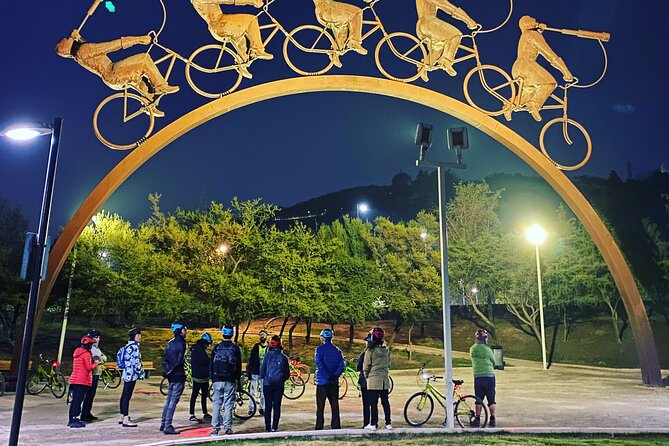
- The route crosses Santiago’s social and architectural contrasts: You move from Las Condes and the World Trade Center area toward Parque de las Esculturas and Bellavista.
- The tour ends in Plaza Mori: Bellavista is the final neighborhood, with a planned Pisco Sour stop and access to bars, food, music, galleries, and street art.
- The group is capped at 12 people: That is a good size for road instructions, questions, and keeping the group together.
- The history focuses on Chile’s modern economic shift: The guide connects the 1990s boom, the rise of Sanhattan, and the return to democracy after 1990.
- A Chilean snack and water are included: Dinner is not, so plan to eat before or after the ride.
- Summer may be the best season: Earlier sunsets, colder evenings, and reduced light can affect how much you see during the ride.
What this evening ride is really about
This is not a bike tour built around a long list of monuments. It is a guided cross-section of modern Santiago. You begin in the eastern part of the city, known for offices, upscale development, and polished public spaces, then finish in Bellavista, a neighborhood tied to art, nightlife, and student life.
That shift is the point. By bicycle, you cover enough ground to see how Santiago’s neighborhoods change in character. You are not simply parked in one district listening to a lecture. You are moving through the city while the workday gives way to evening plans.
The route also offers a useful introduction for a first visit. You will not see every major sight in Santiago, and the tour is not designed as a museum or historic-center circuit. Instead, it gives you a map in your head: Las Condes for economic growth, Parque Bicentenario for city life, Sanhattan for business, Parque de las Esculturas for public art, and Bellavista for culture and nightlife.
More bike rides in Santiago:
- Santiago Markets Small Group Bike Tour
★ 5.0 · 368 reviews - Santiago Highlights, Parks and Politics Bike Tour
★ 5.0 · 264 reviews - Santiago: Markets Bike Tour
★ 4.8 · 107 reviews
Starting at MUT in Las Condes at 7 p.m.
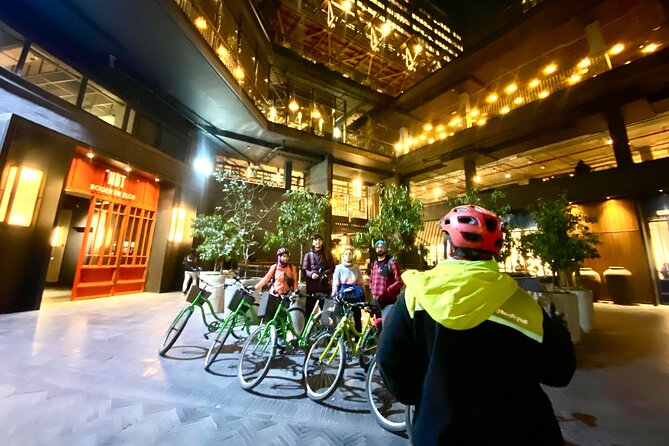
The meeting point is Cafe Altura at Mercado Urbano Tobalaba, known as MUT, at Avenida Apoquindo 2730, on level minus two. The team meets you there, provides the bicycle, and goes over riding instructions and practical tips before setting off.
That opening matters more than it may sound. A short fitting and briefing can make the difference between a comfortable ride and two and a half hours of adjusting your position or wondering where to go. Arrive a few minutes early so the group can begin without a scramble.
The tour starts at 7 p.m., even though the description frames it around the time people leave work and head out for drinks. Depending on the season, you may start with some daylight or move into evening fairly quickly. If you want the strongest sunset colors, ask about the timing when you book, since the supplied details do not promise a particular amount of light.
MUT is near public transportation, which is useful because the tour does not include private transfers. You handle your own way to the start and from the end.
Las Condes and the story of Santiago’s economic boom
After warming up on the bicycle, you stop in Las Condes, described as one of Santiago’s former fanciest districts and located near one of the city’s major highways. The guide uses this area to explain the city’s economic development during the 1990s.
This is one of the tour’s strongest ideas. Modern Santiago can seem like a collection of glass towers, broad roads, and expensive neighborhoods unless someone explains how those areas fit into Chile’s recent story. The discussion connects the physical city with the country’s reputation as the Puma of Latin America during the 1990s, a period associated with strong economic growth.
You should not expect a long academic presentation. The stop lasts about 10 minutes, so the information is likely to be focused and easy to absorb. That makes it a good introduction rather than a complete history lesson.
The trade-off is that this part of the ride may appeal more to people interested in cities, politics, and economics than to visitors seeking colonial buildings or famous monuments. If your idea of Santiago is centered on old churches and historic plazas, this tour takes a different route.
Parque Bicentenario: a look at everyday city life
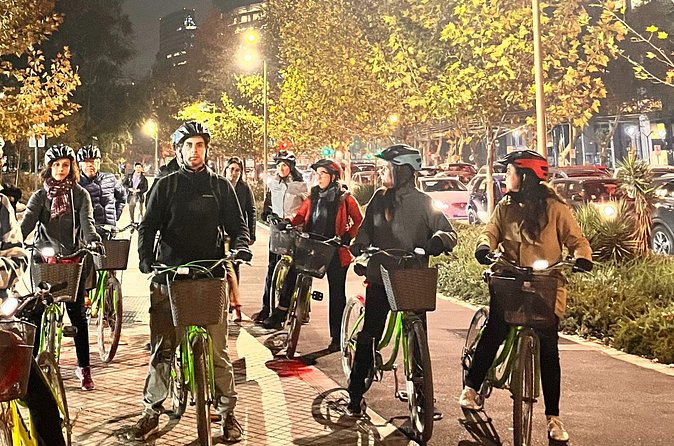
The next major pause is Parque Bicentenario, one of the largest and most attractive parks in eastern Santiago. You spend about 15 minutes here, discussing how local people use public parks and why these spaces matter in daily life.
I like this stop because parks show a city in a way that office towers cannot. You get a chance to watch how people share public space, rather than viewing Santiago only through its commercial districts. The stop also breaks up the cycling with a quiet place to look around and catch your breath.
The park is included for its role in present-day city life, not just for scenery. That gives the ride a more local focus. You are encouraged to understand how Santiago functions after work, when people are out enjoying the evening instead of commuting.
Still, 15 minutes is not enough for a long walk through a large park. You should think of it as a compact stop with explanation, not a full park visit. The ride keeps moving, so wear clothing suited to cycling rather than a sightseeing outfit that only works for standing around.
More things to do in Santiago:
- Valparaiso Port and Viña del Mar with Casablanca Wine Tasting
★ 5.0 · 6,110 reviews - Santiago: Cajon del Maipo/Embalse del Yeso Tour with Picnic
★ 4.3 · 3,789 reviews - Santiago: Vina Del Mar, Valparaiso, Casablanca & Reñaca Tour
★ 4.2 · 2,838 reviews - Cable Car, Funicular and Sightseeing Bus in Santiago one day
★ 5.0 · 2,325 reviews
Sanhattan and the World Trade Center
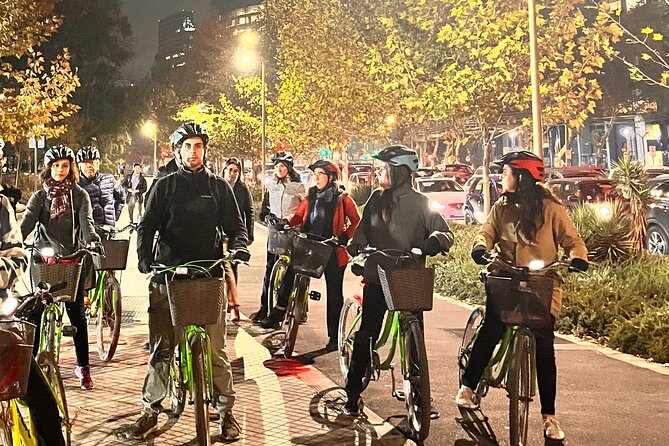
From the park, the route continues toward the World Trade Center Santiago and the area commonly called Sanhattan. The stop lasts roughly 10 minutes and looks at Chile’s present through the country’s difficult past.
The guide links this business district to the years of dictatorship from 1973 to 1990 and the period after Chile returned to democracy. The modern towers and commercial activity then become more than a backdrop. They represent the new direction taken by the country and the city.
This is another reason I would choose the tour for a first or second visit. You see how newer development reflects recent national change. The setting gives the discussion a practical anchor, so the story is tied to streets and buildings rather than floating as disconnected dates.
The short stop also keeps the tone light enough for an evening ride. You get a concise explanation, then return to the bicycle. The tour does not pretend to cover every political issue, and that is probably wise within a 2.5-hour outing.
Parque de las Esculturas brings art outdoors
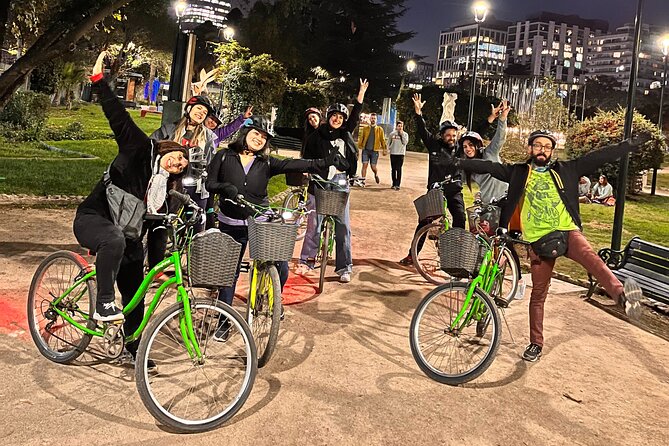
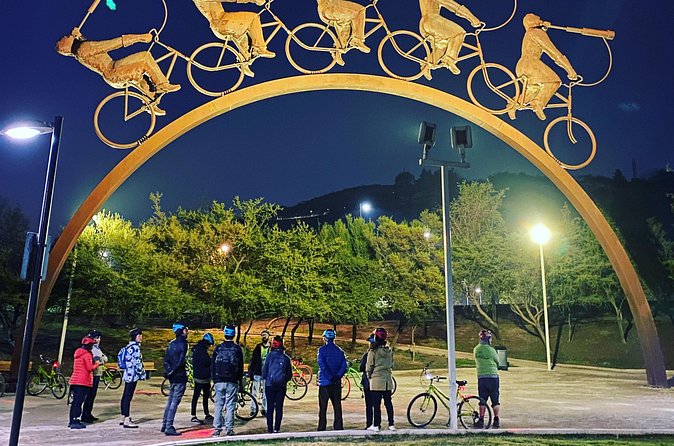
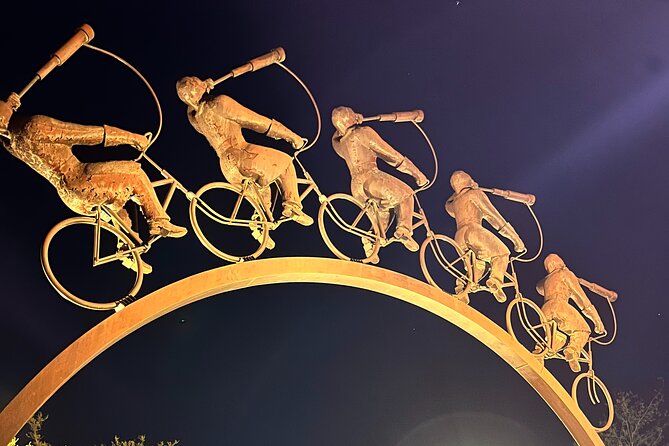
Parque de las Esculturas provides a different mood. The park contains works by major Chilean sculptors, and the stop gives art a central role in the route. Music and wine are also part of the park’s offering, according to the tour information.
You spend around 15 minutes here. That is enough to pause among the sculptures and hear why the place matters, but not enough to inspect every work in detail. If public art interests you, this could be one of the most rewarding stops. If it does not, the park still gives you a change from roads and business districts.
The sequence works well. Parque Bicentenario shows public recreation, while Parque de las Esculturas shows public art. Together, they present a city that uses open spaces for more than traffic and construction.
Do not expect the included snack to replace a meal during this stretch. The tour supplies a local Chilean snack and bottled water, but dinner is not included. You may want to eat before the start or arrange dinner after reaching Bellavista.
Riding toward Bellavista after dark
The ride’s appeal changes as daylight fades. Instead of treating darkness as a problem, the tour uses the evening to show Santiago at the time when people leave work, meet friends, and go out.
That said, visibility and comfort matter. One available assessment of the experience specifically suggested choosing summer, when the evening is warmer and there is more light. I would take that advice seriously. A cool-weather evening may still be enjoyable, but you should bring a layer and be comfortable cycling when it is dark.
The ride requires moderate physical fitness. The supplied details do not give a precise distance, route surface, or amount of climbing, so I would not book it if you are uneasy on a bicycle or rarely ride for more than a short stretch. You do not need to be a competitive cyclist, but you should manage a steady urban ride with several stops.
The group limit of 12 is helpful here. A smaller group allows the guide to give instructions without shouting across a crowd, and it should make stops more personal. It also means the pace is set by the group, not by your private schedule.
Bellavista and the Pisco Sour finish
The final stop is Bellavista, one of Santiago’s best-known areas for artists and nightlife. The route ends around Constitución 153 in Providencia, at Plaza Mori, where you can continue into the neighborhood on your own.
Bellavista gives the ride a lively finish. The area is associated with art galleries, street art, live music, bars, and food, so it feels very different from the office districts at the beginning. Ending here makes practical sense because you can stay for dinner or drinks instead of returning to the starting point.
A Pisco Sour is part of the planned finish, which gives the tour a pleasant Chilean touch. Since dinner is not included, you can use the end of the tour as a handoff to an evening meal. Ask the guide for suggestions if you want help choosing where to continue, though the supplied information does not specify a particular restaurant.
The one limitation is that Bellavista receives only about 30 minutes as a formal stop. That is enough for the drink and a quick look, but it is not enough to experience the neighborhood fully. I would treat Plaza Mori as the end of the guided portion, then keep the rest of your evening open if you want food, music, or more street art.
What the guide adds to the ride
The guide is not only there to lead the bicycle line. The experience depends on someone who can explain Santiago’s districts, keep the group moving, fit the bicycles, and adjust the discussion to the people in front of them.
Carlos is one guide specifically associated with this experience, and the available feedback highlights his entertaining and informative approach. It also notes that he spoke patient Spanish when requested. That is a useful detail if you are practicing Spanish or prefer the tour in Spanish rather than English.
The provider offers an English and Spanish-speaking guide. If language practice is important to you, request your preference in advance. The information does not promise a bilingual presentation throughout, so clarify your choice when arranging the tour.
The guide’s strongest role is linking places together. Las Condes, Sanhattan, the parks, and Bellavista could otherwise feel like unrelated stops. The social and political explanations give the route a clear shape.
Is $50 a fair price?
At $50 per person, this is not the cheapest way to spend an evening in Santiago. You can walk through neighborhoods or visit a park without paying a tour fee. The price makes more sense when you count the bicycle, bottled water, Chilean snack, guide, route planning, and the small group of no more than 12 people.
You are also paying for interpretation. A bicycle rental alone would not explain why the eastern districts look the way they do, how the 1990s changed Santiago, or why the contrast with Bellavista matters.
The value is strongest for first-time visitors who want orientation and context in a short window. It is weaker for anyone who already knows Santiago well or wants a food-focused evening, since dinner is not included and the tour spends only a short time in each place.
Private transportation is not included, but that is less troubling because the start is near public transportation and the end is in a neighborhood where you can continue your night. Remember to budget separately for your journey to MUT and any meal after the Pisco Sour.
Who should book this bike tour?
I would recommend it to you if you:
- Want to understand how different parts of Santiago fit together
- Enjoy city history tied to modern neighborhoods
- Prefer active sightseeing to a bus or van
- Can handle a moderate bicycle ride
- Like small-group tours with time for questions
- Want to finish near bars, food, art, and music
I would be more cautious if you want Santiago’s oldest landmarks, a relaxed walking tour, or a full dinner experience. The route emphasizes eastern Santiago, parks, business development, and Bellavista. It is not a substitute for exploring the historic center.
It also may not suit you if you dislike cycling after sunset or are visiting during a colder season. The tour can still work then, but the available guidance points to summer for warmer conditions and more light.
Booking, weather, and practical details
Your confirmation is issued at booking, and free cancellation is available until 24 hours before the 7 p.m. start time. Changes or cancellations inside that 24-hour window are not accepted for a refund. Cutoff times follow Santiago’s local time.
Good weather is required. If the company cancels because of poor conditions, you can choose another date or receive a full refund.
Bring comfortable clothes for cycling, a layer for the evening, and enough energy for the ride. The bicycle and water are supplied, but the information does not list helmets, lights, or other equipment separately, so ask what is included when you book if those items matter to you.
Final verdict: book it for context, not a checklist
Book the Sunset Mapocho River Bike Tour if you want a compact, active introduction to modern Santiago. The best parts are the neighborhood contrasts, the discussion of Chile’s economic and political changes, the public parks, and the finish in Bellavista with a Pisco Sour.
Choose another experience if your priority is dinner, old-city architecture, or a slow visit to one neighborhood. For the right visitor, $50 buys more than a bicycle ride. It gives you a route through Santiago’s changing identity, with enough local explanation to make the city easier to understand for the rest of your trip.
FAQ
How long is the Sunset Mapocho River Bike Tour?
The tour lasts approximately 2 hours and 30 minutes.
What time does the tour start?
The stated start time is 7 p.m.
Where does the tour begin?
It begins at Cafe Altura at MUT, Avenida Apoquindo 2730, floor minus two, in Las Condes, Santiago.
Where does the tour end?
It ends at Constitución 153 in Providencia, at Plaza Mori in Bellavista.
What is included in the price?
The price includes bicycle use, bottled water, a local Chilean snack, and an English or Spanish-speaking guide.
Is dinner included?
No. Dinner is not included, so you should plan a meal before or after the tour.
How many people can join the tour?
The activity has a maximum of 12 participants.
What level of fitness is needed?
You should have a moderate level of physical fitness because the experience involves cycling for about 2.5 hours.
Can I cancel for a full refund?
Yes. You can cancel at least 24 hours before the start time for a full refund. If poor weather causes the company to cancel the tour, you will be offered another date or a full refund.
Just added in Santiago
- Walking City Tour with Funicular, Cable Car and Tasting★ 4.3 · 6 reviews
- VIÑA DEL MAR AND VALPARAISO TOUR★ 4.8 · 20 reviews
- Tour VIÑA CONCHA Y TORO + CASA MARQUES – Chile, from Santiago.★ 5.0 · 2 reviews
- Undurraga + Isla Negra + San Afonso del Mar —– Full day★ 4.1 · 8 reviews
- Undurraga Wine tour★ 4.2 · 15 reviews
- Southcoast – Private Full-Day tour★ 5.0 · 6 reviews
- Santiago Private walking tour with Lunch★ 5.0 · 5 reviews
- Zapallar : nature, sea and local flavours★ 5.0 · 6 reviews
Cycling Tours, compared.
Santiago Highlights, Parks and Politics Bike Tour
Read our review →
Bike Tour in San Pedro de Atacama – Devil’s Throat
Read our review →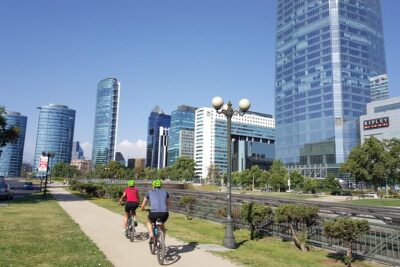

Browse the lists this tour appears in