
REVIEW · WALKING TOURS
Santiago Walking City Tour
Santiago opens up one square at a time. This private walking tour links major sights with local stories, political context, food suggestions, and the everyday life of central Chile. I like the flexible, conversation-led style, and I like that the route ends in Barrio Lastarria, a useful spot for lunch, coffee, or more wandering. The main drawback is simple: you need decent fitness, since Cerro Santa Lucía has uneven paths and uphill sections.
For $229 per group of up to four, the price makes the most sense for couples, families, or friends who want a private guide rather than a large group. Guides such as Juan Pablo, Catalina, and Maria have been praised for clear English, warmth, humor, and their ability to adjust the day around your interests. Just remember that several sights may close on Monday, and the tour depends on good weather.
In This Review
- Key points at a glance
- What this Santiago walking tour is really designed to do
- Bellas Artes begins with art, coffee, and city life
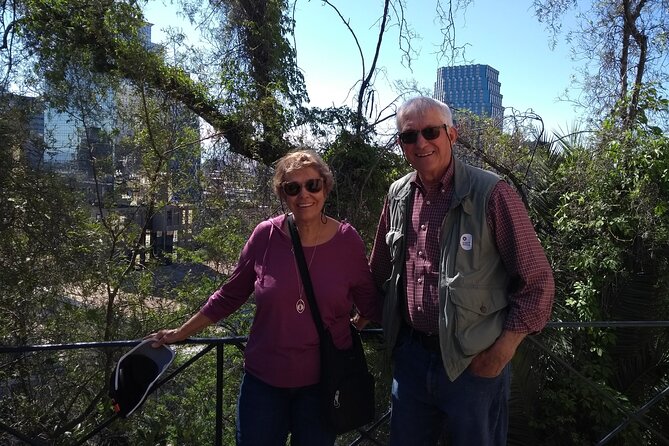
- Cerro Santa Lucía gives the city a breath of air
- La Moneda and Plaza de la Constitución put Chile’s politics in view
- Espacio M offers a short rest and a look at old power
- Supreme Court and former Congress show the country’s institutions
- The Metropolitan Cathedral rewards a quiet pause
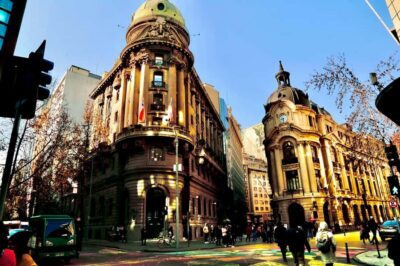
- Plaza de Armas is Santiago’s original civic stage
- Barrio Lastarria is the right place to finish
- The guides are a major part of the value
- Is $229 a fair price?
- Who should book this walk?
- FAQ
- How long does the Santiago Walking City Tour last?
- How much does the tour cost?
- Is this a private tour?
- Where does the tour begin?
- Where does the tour finish?
- Is bottled water included?
- Is the National Museum of Fine Arts always open during the tour?
- Is Cerro Santa Lucía open every day?
- Can I cancel for a full refund?
- Should you book it?
Key points at a glance
- A private route for up to four people: The $229 price is shared by your group, not charged per person.
- The tour connects Santiago’s major civic sights: You visit La Moneda, Plaza de la Constitución, the Supreme Court, the former Congress, the Cathedral, and Plaza de Armas.
- Cerro Santa Lucía adds a welcome green pause: The park gives you quiet paths, lookout points, and a change from downtown traffic.
- The guide brings current Chile into the conversation: The route opens discussion about the 1973 coup, human rights, government, religion, and daily urban life.
- The walk begins and ends in useful neighborhoods: Start near Bellas Artes and finish in Barrio Lastarria, with food and coffee options nearby.
- Monday needs special care: Cerro Santa Lucía is regularly closed then, and the Fine Arts Museum may also be unavailable.
What this Santiago walking tour is really designed to do
This is not just a checklist of monuments. It is a four-hour conversation through central Santiago, with the city’s streets acting as the classroom.
The route covers about 3 hours 30 minutes to 4 hours, depending on pace, access, and how much you stop to talk. The listed timing adds up to roughly 3 hours 50 minutes. Since this is a private activity, your guide can spend more time on subjects that interest you, instead of moving a large group along a fixed script.
That flexibility has real value in Santiago. The city’s architecture is only part of the story. Government, religion, class, commerce, dictatorship, public protest, and modern urban life all meet within a fairly compact downtown area.
The experience begins at Monjitas and Mosqueto, near the Bellas Artes subway station, and finishes at José Victorino Lastarria and Villavicencio. Both ends are near public transportation. You are not being dropped in an isolated parking area or left far from the next part of your day.
The tour includes all fees and taxes. Bottled water is not included, so bring your own bottle.
More City Tours in Santiago
- Private Santiago City Half Day Tour
★ 4.0 · 414 reviews - Santiago: Full day tour to Valparaiso and Viña del Mar city
★ 4.0 · 188 reviews - City tour by Santiago of Chile -A beautiful experience – Half day
★ 4.5 · 176 reviews
Bellas Artes begins with art, coffee, and city life
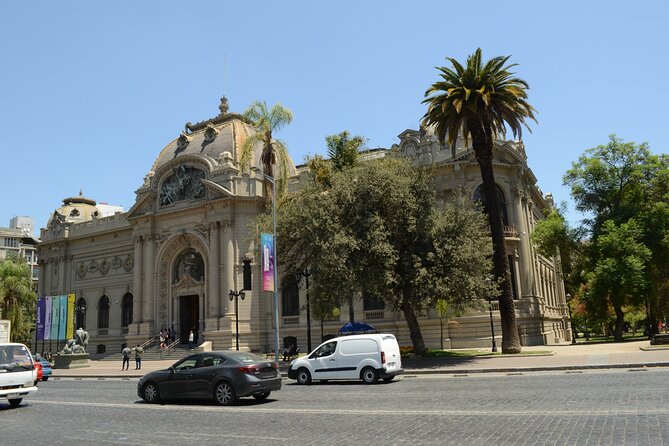
The first stop is the National Museum of Fine Arts, beside the Bellas Artes subway station. The museum itself is free to enter, though access is not guaranteed. It is generally open from 10 a.m. to 6 p.m. except Monday, but strikes or maintenance can change the plan.
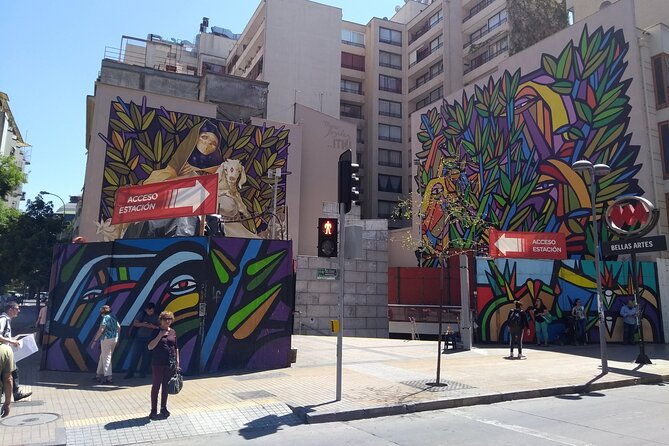
If the museum is closed, the stop still has a purpose. You can examine the building from outside and look at the surrounding Bellas Artes neighborhood, known for cafés, beer, conversation, and the informal social energy of a central Santiago barrio.
The guide uses this first stop to talk about what it means to live in the city today, how the district developed, and how it has weathered recent years. That approach helps you get your bearings without rushing straight into dates and names.
I would treat the museum access as a bonus, not the main reason to book the tour. The useful part is the opening conversation and the setting around the museum. If art is a high priority, check the operating situation before you go and allow extra time for a separate museum visit if needed.
Cerro Santa Lucía gives the city a breath of air
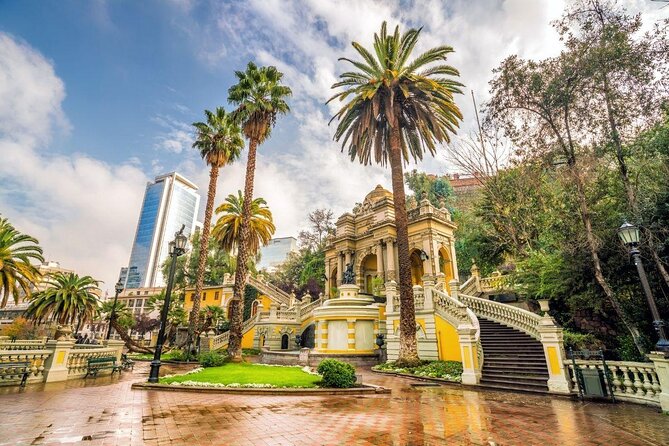
From the urban streets, the tour moves to Cerro Santa Lucía, a small hilltop park in the middle of downtown. It is a welcome change. Traffic noise fades, greenery takes over, and you can pause for photographs and views of nearby Santiago.
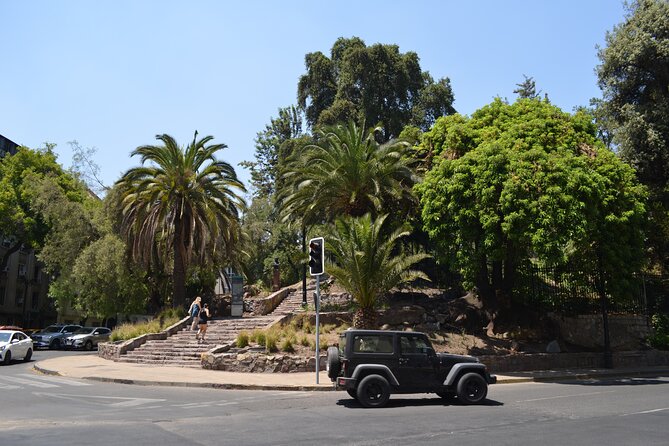
The park has uneven trails and uphill sections. You can stop at the main terrace, or continue toward the tower, depending on your pace and fitness. The route is not a demanding mountain hike, but it is not a flat sidewalk walk either. Wear shoes with a firm grip and take the climb at a comfortable speed.
The views are not a single grand panorama of the entire capital. Instead, the hill gives you several smaller viewpoints, each showing a different part of the city. That is part of its appeal. You can focus on the buildings, streets, and daily activity that interest you rather than simply taking one standard photograph.
This is also a good place for your guide to connect Santiago’s physical setting with its past and present. The conversation continues while you walk, but the quieter surroundings make it easier to listen.
Cerro Santa Lucía is normally closed on Monday. That makes Monday a less suitable day for this particular route unless the operator confirms a change.
La Moneda and Plaza de la Constitución put Chile’s politics in view
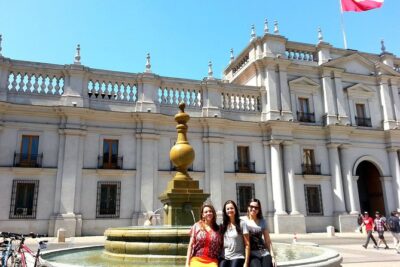
The walk then reaches Plaza de la Constitución, north of La Moneda Palace. The square is surrounded by the machinery of national government, so the mood changes from neighborhood life to civic power.
La Moneda was built as a mint and opened in 1804. It was designed by the Roman architect Joaquín Toesca, who arrived in colonial Santiago in 1780 and did not live to see the building completed. Its construction brought together several techniques and became a major example of colonial craftsmanship.
The square also contains statues of presidents, each tied to a different chapter of Chilean government. Your guide uses the setting to explain how the country’s political institutions developed and how public expectations have changed.
This is where the tour takes on more weight. The 1973 coup took place here, and the site provides a direct setting for discussion of human rights, civic responsibility, and Chile’s hopes for the future. The guide’s role is not to push you toward a particular political view. Instead, the aim is to give you useful context so you can form your own understanding.
I value this part of the walk because it treats Santiago as a living capital, not a museum display. You will hear about difficult subjects. If you prefer a purely light sightseeing tour, this section may feel more serious than expected. For many people, that seriousness is exactly what makes the walk worthwhile.
More Walking Tours in Santiago
- The best walking tour in Santiago de Chile
★ 5.0 · 629 reviews - Santiago Half-Day Walking Tour with Hotel Pick up & Food Sample
★ 4.5 · 467 reviews - A Fabulous Walking tour by the Old Santiago of Chile –
★ 5.0 · 466 reviews - Santiago: Guided Walking Tour of the Historical Old Town
★ 4.8 · 459 reviews
Espacio M offers a short rest and a look at old power
Espacio M occupies the former facility of the newspaper El Mercurio. The commercial gallery opened in 2012 and now presents a more modern, business-oriented side of Santiago.
The stop lasts about 20 minutes. It is also a practical pause, with a bathroom available and the possibility of coffee. Long city walks are better when you do not have to treat every restroom as a major strategic problem.
The guide may also use the building to explain its architecture, construction, and earlier social life. The story brings in the conservative Larraín and Edwards families, whose influence remains part of Chile’s public and private affairs.
This stop is less about a famous single monument and more about showing how newspapers, families, commerce, and politics overlap in the capital. You may find it especially useful if you want more than colonial architecture and government buildings.
Supreme Court and former Congress show the country’s institutions
At Plaza Montt Varas, flat fountains and statues of President Manuel Montt and Antonio Varas face the imposing Supreme Court of Justice.
The square can also reveal the political mood of the day. Demonstrations sometimes take place at the court’s gates, creating a direct link between public frustration and the institution responsible for interpreting justice. Your guide can explain the three branches of government and discuss current public affairs without turning the tour into a debate.
Across from the court is the former National Congress building. A temple once occupied this area and suffered a tragedy, while the current republican institution holds meetings there today. Entrance is not always permitted, despite the public nature of the site, so expect to view it from outside unless access is available.
This short stop is valuable because it makes government less abstract. You are standing among the buildings where laws are debated and justice is administered. It also gives you a chance to ask direct questions about how Chile’s republic works.
The Metropolitan Cathedral rewards a quiet pause
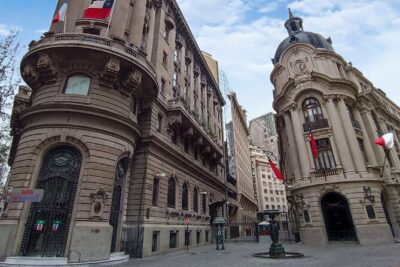
The Metropolitan Cathedral was built and altered over a long period from the mid-18th to the 19th century. It is not the first church to occupy this site. Earlier temples had different designs and structures, and the current building continued to change after its consecration until shortly before the First World War.
Inside, keep your voice low, turn off your camera flash, and do not bring food or drink into the church. Photography is allowed in many areas unless a sign says otherwise. Services take place during the week and on weekends, with noon often the most likely time to visit.
The cathedral contains symbols tied to kindness, martyrdom, patriotism, and religious devotion. The Capilla del Santísimo Sacramento and Parroquia El Sagrario are important parts of the complex and deserve respectful attention.
I like the contrast here. After the direct political discussion around La Moneda and the courts, the cathedral offers a quieter setting for considering the beliefs and symbols that have shaped Chilean public life.
Because services may affect access, this is another stop where patience matters. You are entering an active place of worship, not simply a historic building open for sightseeing.
Plaza de Armas is Santiago’s original civic stage
Plaza de Armas is the tour’s central historical anchor. On February 12, 1541, the main square and governor’s house were established here, traditionally associated with Pedro de Valdivia and the founding of Santiago.
The exact story of the city’s beginnings continues to receive new interpretation, but this square remains closely tied to Santiago’s civic life. In colonial times, the open space served practical needs involving horses, carts, weapons, and defense. Churches, government offices, a jail, a gallows, livestock events, religious celebrations, and public games also gathered around or near the square.
After Chile became a republic, Plaza de Armas remained an important civic center. Today it is also a place for entertainment, commerce, and local tradition. There is usually something to observe, and the guide will help you read the square as more than an open plaza surrounded by buildings.
Allow yourself time to look around. The value is in picturing the many roles this space has played over the centuries, then comparing those older uses with what you see now.
Barrio Lastarria is the right place to finish
The final walk leads through Mosqueto Street toward Barrio Lastarria, close to where the tour began. This neighborhood is filled with cafés, bars, cultural venues, street sellers, and performers.
It is a colorful and noisy finish, with plenty to keep you busy after the guide leaves. You can stay for a meal, find coffee, continue exploring, or simply wander through the streets while you still have the route fresh in mind.
Lastarria also makes the ending practical. You are not finishing beside a single attraction with nowhere to go. You have choices for the rest of your afternoon.
Keep an eye on your direction if you explore alone. The streets can feel confusing at times, particularly when you move between small lanes and busier blocks. That is part of the neighborhood’s charm, but it rewards attention.
The guides are a major part of the value
The strongest part of this experience is likely to be the guide rather than any single monument.
Juan Pablo, often called JP, has been praised for excellent English, strong communication, humor, and wide knowledge of Chilean culture, politics, and history. He speaks several languages and has adjusted tours around personal interests, including hotel pickups and food stops in some cases.
Catalina has also shown flexibility, including meeting a couple at a hotel in Providencia and reshaping the route for a short stopover. Maria has led city walks as well. The available guide depends on the booking, so do not assume you will receive a specific person unless that is confirmed.
The best way to use a private tour is to tell the guide what you care about. You might want more architecture, more politics, more food, or a clearer picture of modern life. The format allows those questions to shape the conversation.
Past tour experiences with the same guiding team have included empanada pino, local snacks, beer, ice cream, and restaurant advice. Those extras are not listed as guaranteed parts of this specific route, so treat them as possible recommendations rather than included features.
Is $229 a fair price?
At $229 for up to four people, the cost works out to about $57.25 per person if your group is full. For two people, it is $114.50 each. That is not the cheapest way to see Santiago, but you are paying for privacy, a dedicated guide, and the chance to ask questions throughout the walk.
The value improves if you are short on time. One couple booked after an early arrival and used the tour to fill the gap before hotel check-in. Another group with a short Santiago stopover benefited from a flexible route and a longer outing.
The price is less attractive if you only want quick exterior photographs or prefer exploring independently with a map. Santiago’s central sights can be visited without a private guide. The tour earns its cost through interpretation, local perspective, and time saved deciding what each building means.
Who should book this walk?
I would recommend it most to first-time visitors, couples, families, and small groups who want a strong introduction to Santiago. It also suits anyone interested in Chile’s politics, civic life, religion, architecture, or changing neighborhoods.
It is a good choice for a stopover because the route covers many major central sights in one outing. It can also help you decide what deserves a second visit later.
You should think twice if you have difficulty with uneven paths, if you want a fully flat route, or if you dislike serious political discussion. The walk is manageable for people with moderate fitness, but Cerro Santa Lucía requires care.
Free cancellation is available up to 24 hours before the start time. If poor weather cancels the experience, you are offered another date or a full refund. Changes made within 24 hours are not accepted, and the local-time cutoff applies.
FAQ
How long does the Santiago Walking City Tour last?
The tour lasts approximately 3 hours 30 minutes to 4 hours. The listed stops add up to about 3 hours 50 minutes.
How much does the tour cost?
The price is $229 per group, with up to four people included.
Is this a private tour?
Yes. Only your own group participates in the activity.
Where does the tour begin?
It begins at Monjitas and Mosqueto, near the Bellas Artes area in Santiago.
Where does the tour finish?
The tour ends at José Victorino Lastarria and Villavicencio in Barrio Lastarria.
Is bottled water included?
No. Bottled water is not included, so you should bring your own.
Is the National Museum of Fine Arts always open during the tour?
No. It is generally closed on Monday and may also be unavailable because of a strike or maintenance. Its usual stated opening hours are 10 a.m. to 6 p.m.
Is Cerro Santa Lucía open every day?
Cerro Santa Lucía is regularly closed on Monday. The park also has uneven trails and uphill sections.
Can I cancel for a full refund?
Yes, if you cancel at least 24 hours before the experience starts. Cancellations made less than 24 hours in advance are not refunded.
Should you book it?
Book this tour if you want Santiago explained as a working city, not just photographed as a collection of monuments. The route gives you art, a hilltop park, government buildings, courts, a cathedral, the city’s founding square, and a lively cultural neighborhood in one well-shaped walk.
The best reason to choose it is the private format and the guide’s ability to connect Chile’s past with current public life. Choose another option if you want a cheap, flat, self-guided stroll or guaranteed museum and building access.
For a small group with limited time, moderate fitness, and genuine curiosity about Chile, this is a strong introduction. Start early enough to account for museum hours and Monday closures, wear practical shoes, carry water, and arrive ready to ask questions.
Just added in Santiago
- Walking City Tour with Funicular, Cable Car and Tasting★ 4.3 · 6 reviews
- VIÑA DEL MAR AND VALPARAISO TOUR★ 4.8 · 20 reviews
- Tour VIÑA CONCHA Y TORO + CASA MARQUES – Chile, from Santiago.★ 5.0 · 2 reviews
- Undurraga + Isla Negra + San Afonso del Mar —– Full day★ 4.1 · 8 reviews
- Undurraga Wine tour★ 4.2 · 15 reviews
- Southcoast – Private Full-Day tour★ 5.0 · 6 reviews
- Santiago Private walking tour with Lunch★ 5.0 · 5 reviews
- Zapallar : nature, sea and local flavours★ 5.0 · 6 reviews
Walking Tours, compared.

Walk with Penguins on Magdalena & Marta Island
Read our review →
Santiago Half-Day Walking Tour with Hotel Pick up & Food Sample
Read our review →
A Fabulous Walking tour by the Old Santiago of Chile –
Read our review →
Santiago Half-Day Walking Tour with Hotel Pick up & Brunch
Read our review →
Santiago Skyline: Cable Car & San Cristobal Walking Tour
Read our review →Browse the lists this tour appears in