
REVIEW · WALKING TOURS
La Moneda Palace, Plaza de Armas & Historic Santiago Walking Tour
Santiago tells its story on foot. This 2.5-hour walk links presidential power, colonial churches, grand civic squares, markets, and hilltop views in one compact introduction to Chile’s capital. I especially like the small maximum of 10 people, which gives the guide room to answer questions, and the route’s mix of major landmarks and quieter streets such as Paseo Nueva York. Guides including Emmanuel, Felipe, and Paul have been praised for making Chilean history clear, friendly, and engaging.
The main drawback is that the tour crosses parts of central Santiago where you need to stay alert with jewelry, phones, and bags. A bracelet and a necklace were reportedly snatched during separate walks, so I would leave valuables at your hotel and listen carefully to the guide’s safety advice.
In This Review
- Key points to know before you book
- Starting beside O’Higgins and Chile’s civic center
- La Moneda Palace and the weight of political history
- Colonial Santiago at San Francisco Church
- From Paseo Estado to the unexpected Paseo Nueva York
- The Stock Exchange and Santiago’s commercial ambition
- Plaza de Armas, the city’s historic meeting place
- The Metropolitan Cathedral and Santiago’s religious center
- Historic Congress grounds, Mercado Central, and the Mapocho connection
- Climbing Santa Lucía Hill to finish
- What the $29 price really buys you
- Safety, pace, and practical planning
- Who should book this Santiago walk?
- Should you book it?
- FAQ
- How long does the Santiago walking tour last?
- How much does the tour cost?
- Where does the tour begin?
- Where does the tour end?
- What language is the tour offered in?
- Is transportation included?
- How large is the group?
- Can I cancel for a full refund?
Key points to know before you book
- A compact history lesson: In roughly 2 hours 30 minutes, you move from Chile’s colonial beginnings to its presidential, religious, commercial, and artistic life today.
- Small-group format: The tour has a maximum of 10 participants, a useful size for questions and a more personal pace.
- Strong guide-dependent experience: Emmanuel, Felipe, and Paul have received especially warm praise for clear explanations and an easygoing manner.
- Mostly an exterior sightseeing walk: You see La Moneda, the Stock Exchange, Casa Colorada, Congress grounds, and other landmarks from the route, with entry into churches and historic sites only when access is available.
- A worthwhile finish: Santa Lucía Hill provides stairways, fountains, historic features, and panoramic city views before you continue by public transport.
- Safety matters downtown: Keep valuables out of sight, avoid wearing noticeable jewelry, and stay close to the group when crossing streets.
Starting beside O’Higgins and Chile’s civic center
The meeting point is by the Monument to General Bernardo O’Higgins Riquelme on Avenida Libertador Bernardo O’Higgins. This is a practical starting place because the walk immediately leads into Santiago’s main civic zone, rather than spending precious tour time on a long transfer.
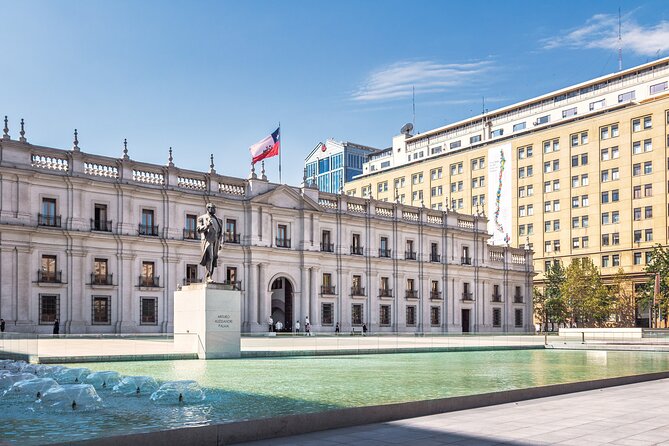
Your first stop is Plaza de la Ciudadanía, also called Citizenship Park. It stretches between the southern side of La Moneda Palace and the Alameda, Santiago’s principal avenue. The plaza was redesigned in 2006 as part of Chile’s Bicentennial Project, giving the area a broad, modern appearance with water mirrors and the monumental Bicentennial Flag.
Look below the plaza as well as ahead. The underground Centro Cultural La Moneda hosts exhibitions and cultural events, adding a contemporary cultural layer beneath the political center. The plaza also contains the Altar de la Patria, where Bernardo O’Higgins rests, along with statues honoring figures from Chile’s independence movement.
The stop is scheduled for only about five minutes, so think of it as an introduction rather than a full visit to the cultural center. If an exhibition interests you, you may want to return later on your own.
More Walking Tours in Santiago
- The best walking tour in Santiago de Chile
★ 5.0 · 629 reviews - Santiago Half-Day Walking Tour with Hotel Pick up & Food Sample
★ 4.5 · 467 reviews - A Fabulous Walking tour by the Old Santiago of Chile –
★ 5.0 · 466 reviews
La Moneda Palace and the weight of political history
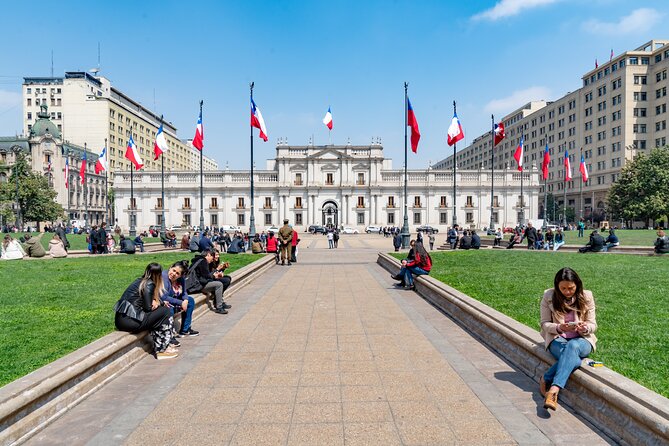
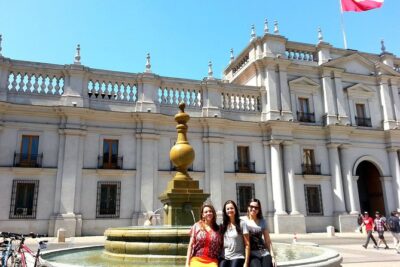
La Moneda Palace is one of Santiago’s essential sights. Completed in 1805, it was first built as a colonial mint. Its name comes from that original purpose, and its neoclassical façade now houses the President and important government ministries.
From the surrounding plazas, you can study the building’s columns, courtyards, and formal proportions. The tour helps connect the architecture with Chile’s political life, including the palace’s role as a symbol of national resilience. You should not expect a full interior tour here. The planned visit focuses on the exterior and nearby public spaces, and the stop lasts about five minutes.
Plaza de la Constitución, on the north side of La Moneda, gives you another angle. This broad square has hosted major public events and demonstrations and remains closely tied to the country’s government. Neoclassical buildings frame the space, while gardens and monuments offer a calmer place to pause and consider how much political history has played out within a few city blocks.
I like this part of the route because the guide can turn a formal building into a readable chapter of Chilean history. Without context, La Moneda is simply an impressive white palace. With context, its location and architecture say much more about power, independence, government, and public memory.
Colonial Santiago at San Francisco Church
The walk then shifts from government to religion and colonial survival. The Church of San Francisco dates to 1618 and is the oldest standing building in Santiago. It has survived the earthquakes that have repeatedly reshaped the city, making the structure itself an important part of the story.
The church contains religious art and offers a glimpse of Santiago’s Spanish colonial roots. If the church is open, the guide may take you inside as part of the included access to select churches and historic landmarks. Because entry depends on availability, keep your expectations flexible.
The scheduled stop is brief, around five minutes. That is enough for an explanation and a quick look, but not enough for a slow study of every painting or architectural detail. If colonial art is a major interest, note the church’s location and return independently with more time.
From Paseo Estado to the unexpected Paseo Nueva York
Paseo Estado brings you through one of the busiest pedestrian streets in central Santiago. Shops, older façades, and constant city movement show the commercial side of downtown. This section helps you see how colonial landmarks sit beside ordinary modern city life.
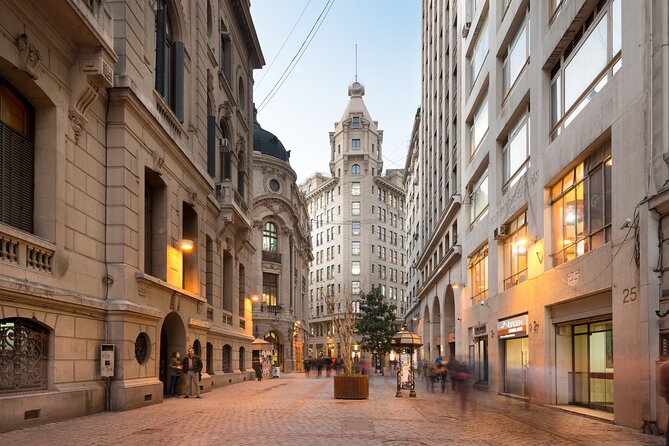
Then the mood changes at Paseo Nueva York. This short street has early 20th-century neoclassical buildings and an unusually European and American feel. Its name is not accidental: Santiago’s leaders and developers once looked to major world cities as models for modernization.
The contrast makes this one of the more enjoyable details of the walk. You move from a busy shopping corridor into a quieter architectural pocket in only a few steps. The stop lasts about five minutes, which is enough to take photographs and hear why the street looks so different from the surrounding center.
The route is not only about famous buildings. Details such as Paseo Nueva York show how Santiago wanted to present itself during a period of economic growth and urban change.
More history tours in Santiago:
- Santiago: Guided Walking Tour of the Historical Old Town
★ 4.8 · 459 reviews - Tour Viña Santa Rita: History, Wine and Picnic Outdoors
★ 4.5 · 141 reviews - Viña Del Mar and Valparaiso world heritage site.
★ 4.5 · 89 reviews - Essence of Santiago : History, Flavors and Panoramic Views
★ 5.0 · 45 reviews
The Stock Exchange and Santiago’s commercial ambition
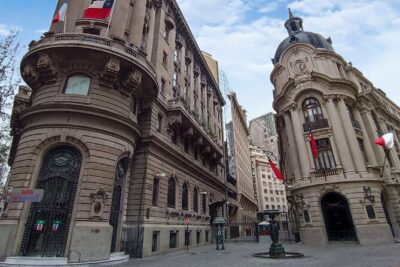
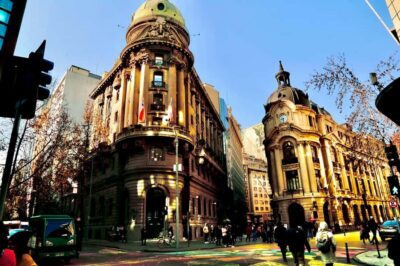
The Santiago Stock Exchange dates to 1893 and occupies a French-style building. Its design reflects the city’s late 19th-century economic confidence and Chile’s growing links with international markets.
You see the building from the outside, rather than entering for a working market session. Still, the stop adds useful balance to the tour. La Moneda explains political power, while the Stock Exchange points to financial power and the country’s place in global commerce.
Nearby, the route passes Casa Colorada, one of Santiago’s best-preserved colonial mansions. Built in 1769, its red façade is easy to recognize. It was associated with important figures during Chile’s independence movement and helps you picture the domestic architecture of the colonial city, rather than only its churches and public squares.
The Church of St. Augustine adds another religious landmark. Built in the early 1600s, it is known for baroque features and the statue of Cristo de Mayo. The crucifix is tied to a famous earthquake story, giving the guide a chance to connect faith, local legend, and the natural forces that have shaped Santiago.
These unscheduled-looking additions are useful because they keep the walk from feeling like a straight march between only the most famous squares. You get short explanations as you pass, even though not every building receives a long stop.
Plaza de Armas, the city’s historic meeting place
Plaza de Armas is the center of old Santiago. The city was founded in 1541, and this square has served as its main public space for centuries. Today, it remains a place where local daily life and national history share the same pavement.
The square is surrounded by important buildings and filled with street artists, performers, and people going about their day. The ten-minute stop gives you time for photographs and a sense of how the city uses this space now.
I consider Plaza de Armas one of the strongest parts of the experience because it brings the earlier stops together. The cathedral, government buildings, colonial streets, and modern commercial center all connect here. You are not just looking at an old plaza. You are seeing Santiago’s central stage, still in use.
Keep your belongings close in this area. As in much of the downtown route, crowds and street crossings create opportunities for theft. A secure crossbody bag worn in front is sensible, and conspicuous necklaces or bracelets are best left behind.
The Metropolitan Cathedral and Santiago’s religious center
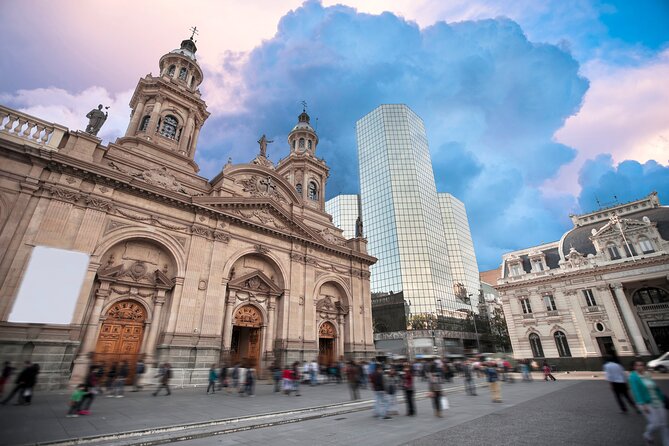
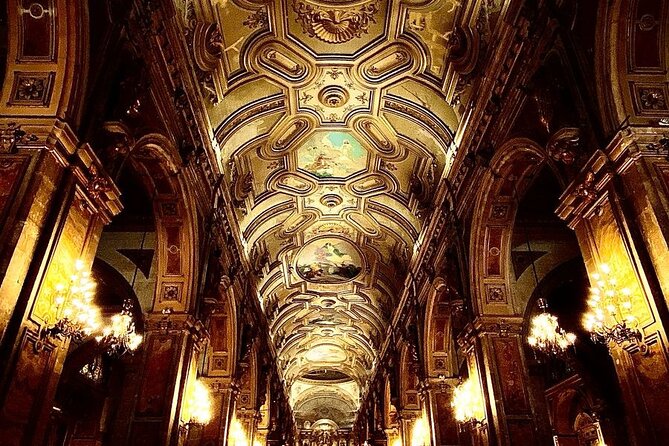
The Metropolitan Cathedral faces Plaza de Armas and serves as the seat of the Catholic Church in Chile. Built between the 18th and 19th centuries, it has a neoclassical exterior and a richly decorated interior.
The stop is about five minutes, so the guide’s explanation helps you focus on the most important features. If the doors are open and services do not interfere, you may enter with the group. Dress and behavior should be respectful, as this remains an active place of worship.
The cathedral is especially useful for understanding Santiago’s long religious and civic traditions. Its location beside the city’s main square shows how closely church, government, and public life were linked in the historic center.
Historic Congress grounds, Mercado Central, and the Mapocho connection
The route also passes the former National Congress building, a grand 19th-century neoclassical structure surrounded by gardens. It is another reminder that Santiago’s political story is not contained within La Moneda alone.
Mercado Central lies farther along the route. Opened in 1872, this famous seafood market occupies an iron structure designed in Britain. It is known for fresh seafood and a lively atmosphere, making it one of the better places to return for Chilean food after the walk.
The market is included as a passing point rather than a full meal stop, so do not count on having time to sit down and eat during the tour. That is actually helpful for keeping the walk on schedule. Your guide can point it out, then you can return when you are ready for lunch.
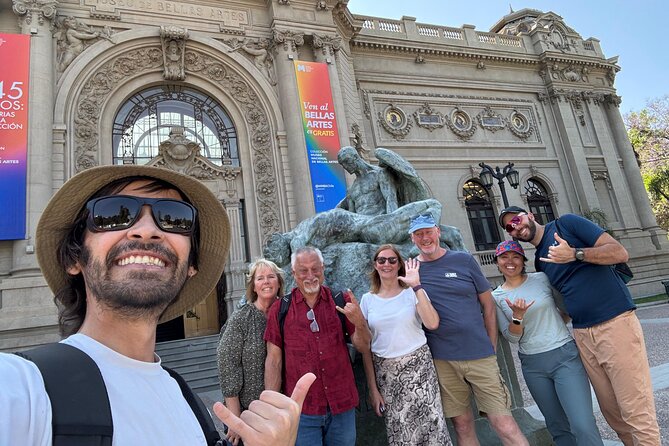
Parque Forestal follows the Mapocho River and offers a greener side of central Santiago. Designed in the late 19th century, it is used by locals for walking, exercise, and relaxation. The park also links important cultural sites, including the Museo Nacional de Bellas Artes.
The museum occupies a Beaux-Arts building from 1910 and holds one of Latin America’s oldest art collections. Like the market, it is generally a point of orientation rather than a full museum visit on this tour. If art matters to you, write down the location and plan a separate visit.
Climbing Santa Lucía Hill to finish
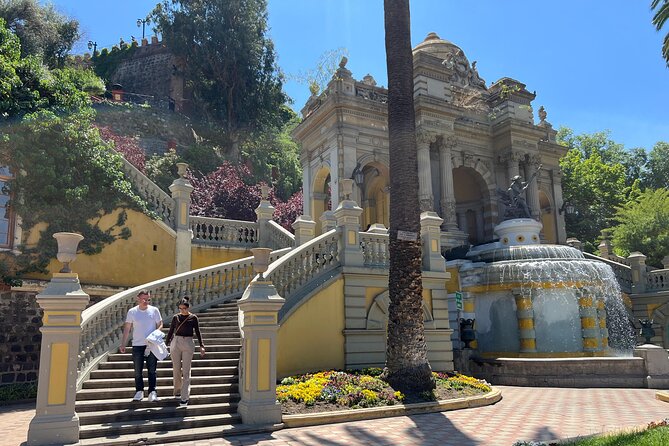
The final major stop is Cerro Santa Lucía, or Santa Lucía Hill. Santiago was officially founded here in 1541, when the rocky outcrop formed a natural landmark in the center of the new settlement.
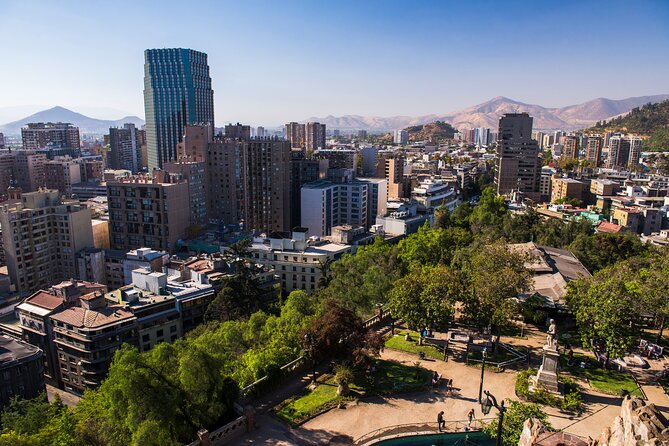
Today, the hill is a landscaped urban park with stairways, fountains, and historic features. The walk ends in front of Neptune’s Terrace, where you can enjoy views over Santiago and reach several transport options afterward.
The final stop lasts about 15 minutes. That is enough to climb to a viewpoint and take in the city, though it is not a long hilltop visit. The route may include stairs, so comfortable shoes are a smart choice. The end point is well chosen: after a dense downtown walk, you get open views and a clear sense of where the central districts sit.
The hill’s best value is the combination of history and orientation. You learn that this is where Santiago began, then look out over the city that grew around it. I would save a little energy for this final section instead of treating it as just another photo stop.
What the $29 price really buys you
At $29 per person, the tour is priced as an affordable introduction rather than a full-day cultural program. You are paying for a certified local guide, a narrated route, access to churches and historic landmarks when possible, photo stops, and suggestions for food, shopping, and later activities.
The value is strongest if you are new to Santiago and want the city explained before exploring alone. In 2.5 hours, you cover a large area and learn how the palace, cathedral, churches, markets, parks, financial buildings, and historic squares relate to one another.
The value is weaker if you want extended interior visits. Most stops are short, and several major places are seen from outside. You are buying orientation, context, and local guidance, not museum-level time at each site.
A maximum of 10 people improves the deal. A large group would make street crossings slower and questions harder. With a small group, the guide can keep the pace flexible and respond to your interests.
The experience has a 4.8 rating from 20 published ratings, with 95 percent recommending it. The positive pattern is clear: guides are appreciated for making history understandable and keeping the walk organized and entertaining. Emmanuel received praise for his clear local explanations, Felipe for connecting La Moneda and Santa Lucía Hill, and Paul for his welcoming manner.
Safety, pace, and practical planning
Santiago’s center can be rewarding and rough around the edges at the same time. One person reported a gold necklace being ripped away while crossing a street with the group. Another described a companion losing a bracelet and felt that parts of the area were unpleasant and unsafe.
Take those incidents seriously without letting them define the whole city. Do not wear valuable jewelry. Keep your phone away when you are not using it, carry your bag in front, and stay with the group at crossings. The operator says safety reminders are given at the beginning, but you should still use your own judgment.
The tour is conducted in English or Portuguese. Transportation is not included, so you must reach the O’Higgins monument on your own and arrange your onward journey from Santa Lucía Hill. The ending is convenient because several transport methods are available nearby.
Most people can participate, and service animals are allowed. Confirmation arrives at booking. You can cancel for a full refund up to 24 hours before the start time, while cancellations or changes made within 24 hours are not accepted for a refund.
Who should book this Santiago walk?
I would choose this tour for a first or second day in Santiago. It gives you a useful mental map, points out places worth revisiting, and explains the city’s political and colonial past without requiring a full day of sightseeing.
It also suits anyone who prefers history delivered by a person rather than a guidebook. Emmanuel, Felipe, and Paul show the kind of friendly, clear guiding that can make a complicated national story easier to follow.
You may want something else if your priority is food, art, or detailed interior access. Mercado Central and the Fine Arts Museum are only brief route points, and La Moneda is viewed mainly from the outside. Independent visitors who already know central Santiago may find the pace too introductory.
Should you book it?
Book this walk if you want a small-group introduction to Santiago’s historic center for a reasonable price. The route is broad, the final view from Santa Lucía Hill is worthwhile, and the best guides make the political and architectural details easy to understand.
Go with modest expectations about interiors and keep your valuables secured. If you do that, this is a practical way to connect Santiago’s colonial beginnings, republican institutions, religious landmarks, and modern city life in one morning or afternoon.
FAQ
How long does the Santiago walking tour last?
The tour lasts approximately 2 hours and 30 minutes.
How much does the tour cost?
The listed price is $29 per person.
Where does the tour begin?
It begins at the Monument to General Bernardo O’Higgins Riquelme on Avenida Libertador Bernardo O’Higgins, 8330109 Santiago.
Where does the tour end?
The tour ends at Santa Lucía Hill, in front of Neptune’s Terrace, with access to several transportation methods.
What language is the tour offered in?
A certified local guide conducts the tour in English or Portuguese.
Is transportation included?
No. Transportation to the starting point and after the tour is not included.
How large is the group?
The tour has a maximum of 10 participants. Arrangements can be made for parties of 10 or more while maintaining small-group attention.
Can I cancel for a full refund?
Yes. You can cancel at least 24 hours before the local start time for a full refund. Cancellations and changes made less than 24 hours before the start time are not accepted for a refund.
Just added in Santiago
- Walking City Tour with Funicular, Cable Car and Tasting★ 4.3 · 6 reviews
- VIÑA DEL MAR AND VALPARAISO TOUR★ 4.8 · 20 reviews
- Tour VIÑA CONCHA Y TORO + CASA MARQUES – Chile, from Santiago.★ 5.0 · 2 reviews
- Undurraga + Isla Negra + San Afonso del Mar —– Full day★ 4.1 · 8 reviews
- Undurraga Wine tour★ 4.2 · 15 reviews
- Southcoast – Private Full-Day tour★ 5.0 · 6 reviews
- Santiago Private walking tour with Lunch★ 5.0 · 5 reviews
- Zapallar : nature, sea and local flavours★ 5.0 · 6 reviews
Walking Tours, compared.

Walk with Penguins on Magdalena & Marta Island
Read our review →
Santiago Half-Day Walking Tour with Hotel Pick up & Food Sample
Read our review →
A Fabulous Walking tour by the Old Santiago of Chile –
Read our review →
Santiago Half-Day Walking Tour with Hotel Pick up & Brunch
Read our review →
Santiago Skyline: Cable Car & San Cristobal Walking Tour
Read our review →Browse the lists this tour appears in