
REVIEW · WALKING TOURS
La Moneda Changing of Guard & Historic Santiago Walking Tour
History marches into view here. This 2.5-hour walk links Santiago’s most important civic spaces with old churches, colonial buildings, and a front-row look at the Changing of the Guard at La Moneda Palace. I like the small maximum group of 10, and I like that the route ends on Santa Lucía Hill, where you can look back over the city center.
The main consideration is pace. You cover a lot of ground, with many stops lasting only five minutes. If you want long museum visits or detailed time inside every church, this is not that kind of outing. It is a brisk introduction to central Santiago, led in English, Portuguese, or Spanish.
In This Review
- Key points to know before booking
- Starting beside the O’Higgins monument
- Citizenship Park and the civic face of Santiago
- The Changing of the Guard at La Moneda Palace
- Plaza de la Constitución and Chile’s political center
- From the Stock Exchange to Paseo Nueva York
- San Francisco Church and Barrio París-Londres
- Paseo Estado, St. Augustine, and Casa Colorada
- Plaza de Armas and the Metropolitan Cathedral
- The former Congress and the National Museum of Fine Arts
- Climbing Santa Lucía Hill to Neptune’s Terrace
- What the $39 price really buys you
- Pace, comfort, and who should book
- Should you book this Santiago walking tour?
- FAQ
- How long does the La Moneda and Santiago walking tour last?
- What time does the tour start?
- Where does the tour begin?
- Where does the tour end?
- Is the Changing of the Guard included?
- What languages are available?
- How large is the tour group?
- Can I cancel for a full refund?
Key points to know before booking
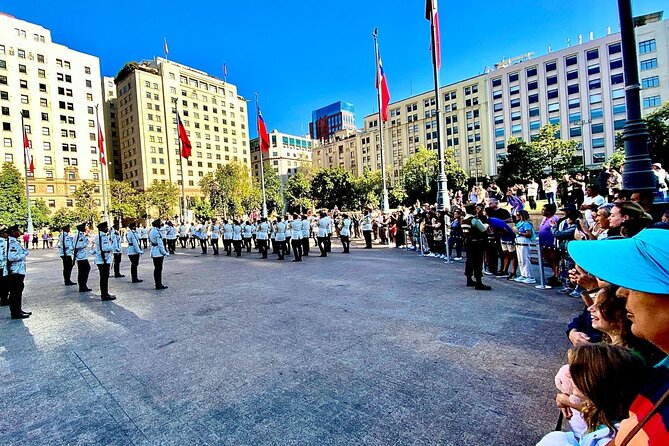
- The Changing of the Guard is the centerpiece: You get a first-row view of the ceremony outside Chile’s presidential palace, with uniformed soldiers and a live military band.
- The group is capped at 10 people: That gives the guide room to answer questions and keep the walk personal.
- The route covers Santiago’s political, religious, and commercial core: You visit La Moneda, Plaza de Armas, old churches, Paseo Estado, Barrio París-Londres, and more.
- Santa Lucía Hill provides the finish: The tour ends at Neptune’s Terrace, with panoramic city views and several transport options nearby.
- Guides add a human touch: Emmanuel is praised for connecting buildings with Chile’s culture, past, and future, while Ignacia is praised for her clear passion for the city.
- The $39 price is reasonable for a short orientation: The value is strongest if you want a guided overview and the ceremony, not if you plan to spend hours inside individual attractions.
Starting beside the O’Higgins monument
The tour begins at the Monument to General Bernardo O’Higgins Riquelme on Avenida Libertador Bernardo O’Higgins at 9:30 a.m. This is a fitting starting point. O’Higgins played a major role in Chile’s independence, and the morning walk soon moves into spaces built around national identity and government.
I would arrive a little early. The tour uses a mobile ticket, and confirmation is sent when you book. Since the group can include no more than 10 people, finding your guide at the monument should be manageable, but a busy downtown street is never the place to arrive at the last second.
The guide leads in English, Portuguese, or Spanish. The supplied guide information lists a certified local expert, and two guides receive especially warm praise: Emmanuel for his thoughtful discussion of Chile’s culture and future, and Ignacia for the energy she brings to the walk. Your guide may be different, but those comments point to the kind of tour this aims to be: more than a list of dates and façades.
More Walking Tours in Santiago
- The best walking tour in Santiago de Chile
★ 5.0 · 629 reviews - Santiago Half-Day Walking Tour with Hotel Pick up & Food Sample
★ 4.5 · 467 reviews - A Fabulous Walking tour by the Old Santiago of Chile –
★ 5.0 · 466 reviews
Citizenship Park and the civic face of Santiago
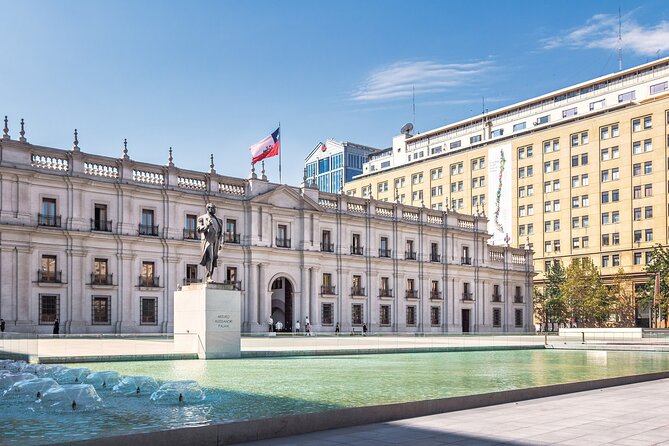
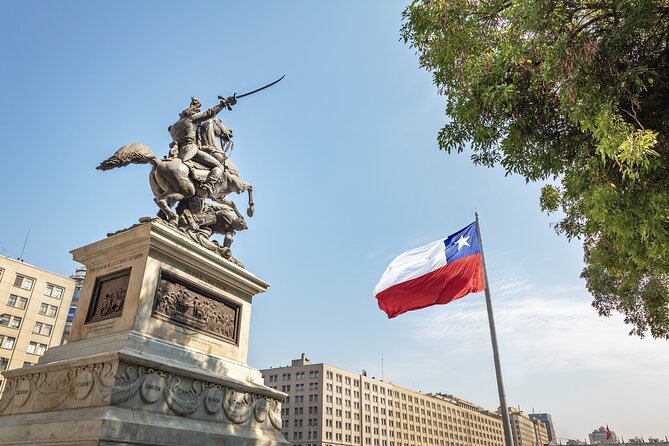
The first stop is Plaza de la Ciudadanía, also called Citizenship Park. The plaza stretches between the southern side of La Moneda Palace and Avenida Libertador Bernardo O’Higgins, creating a broad civic approach to the seat of government.
The design dates from a 2006 redevelopment connected to Chile’s Bicentennial Project. You will see long water mirrors, the monumental Bicentennial Flag, and the underground Centro Cultural La Moneda. The cultural center hosts exhibitions and events, although entry to an exhibition is not part of this walking tour.
The plaza also contains the Altar de la Patria, connected to Bernardo O’Higgins, along with statues honoring leaders of Chile’s independence. This short stop helps explain why La Moneda is not simply a government building. It is surrounded by symbols that connect the modern republic with the country’s struggle for independence.
You have about five minutes here, so think of it as a setting-the-stage stop. The guide can point out the major features, but you will not have time to explore the cultural center or study every monument at length.
The Changing of the Guard at La Moneda Palace
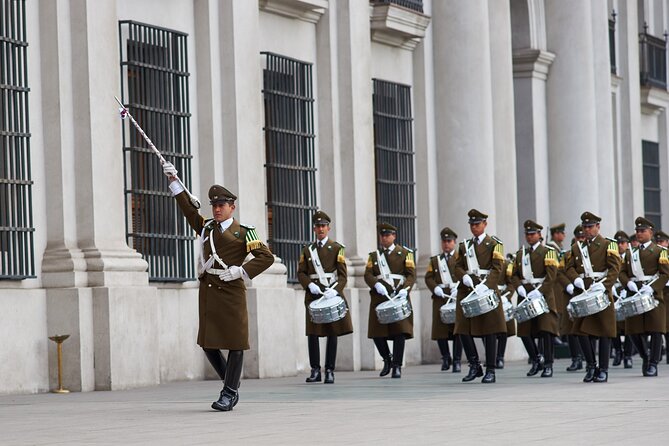
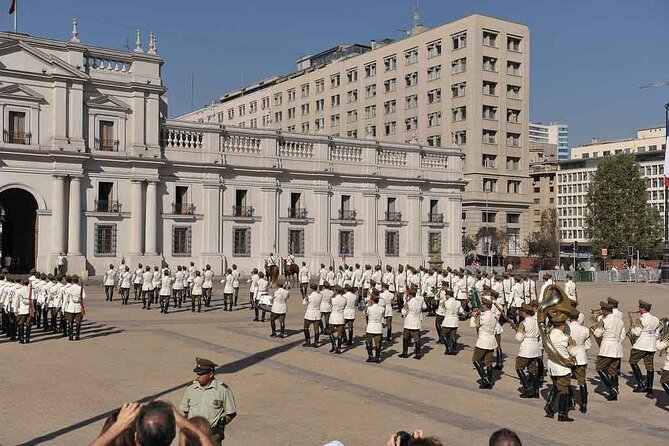
The ceremony at La Moneda is the tour’s main event. The palace is Chile’s presidential headquarters, and the Changing of the Guard offers a formal, colorful display of military tradition in front of one of Santiago’s most important buildings.
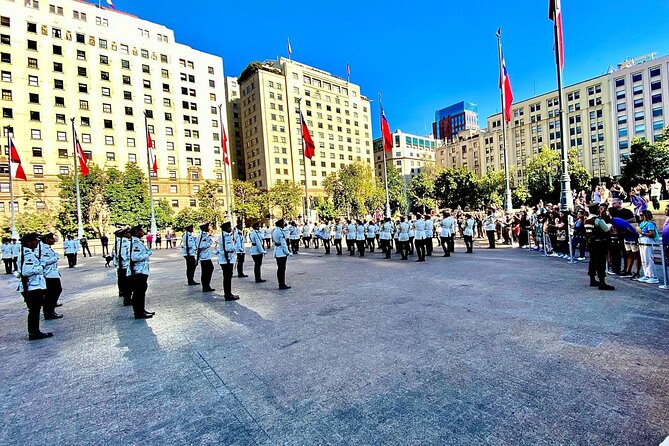
You are promised a first-row view, which matters. A ceremony can lose much of its appeal when you are standing behind a crowd with only glimpses of uniforms and instruments. From the front, you can better follow the parade, the precise movements of the soldiers, and the live military band playing traditional Chilean marches.
The scheduled time here is about 45 minutes, by far the longest pause on the route. That gives the ceremony room to unfold and gives the guide time to explain why it remains part of Chile’s public life.
I appreciate that the tour places the guard ceremony early. You are not asked to spend the morning rushing through landmarks and then hope the main attraction still fits. The possible downside is that ceremony timing is naturally less flexible than a normal sightseeing stop. Keep the morning free and avoid scheduling another appointment too tightly afterward.
Plaza de la Constitución and Chile’s political center
After La Moneda, the walk continues to Plaza de la Constitución. This large square is another important place for understanding Chile’s government and political life.
The plaza is bordered by neoclassical buildings and has hosted major public events and demonstrations. It offers a calmer counterpoint to the ceremony, giving you a chance to consider the role of La Moneda within the city rather than viewing it only as a backdrop for soldiers and music.
The stop lasts about five minutes. That is enough for orientation and photos, but not a detailed architectural survey. The guide’s commentary is especially useful here because the square’s importance is political and historical, not just visual.
More history tours in Santiago:
- Santiago: Guided Walking Tour of the Historical Old Town
★ 4.8 · 459 reviews - Tour Viña Santa Rita: History, Wine and Picnic Outdoors
★ 4.5 · 141 reviews - Viña Del Mar and Valparaiso world heritage site.
★ 4.5 · 89 reviews - Essence of Santiago : History, Flavors and Panoramic Views
★ 5.0 · 45 reviews
From the Stock Exchange to Paseo Nueva York
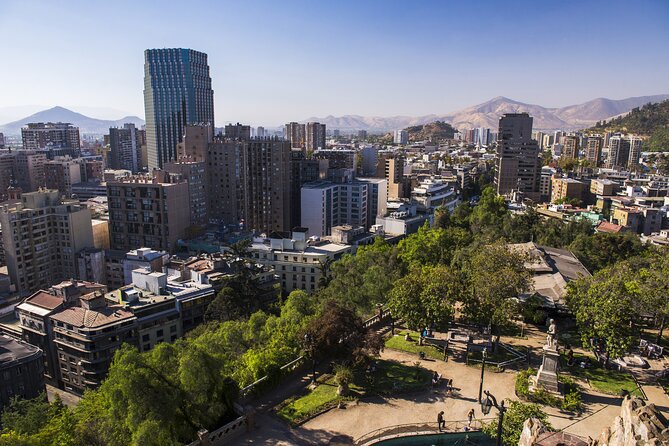
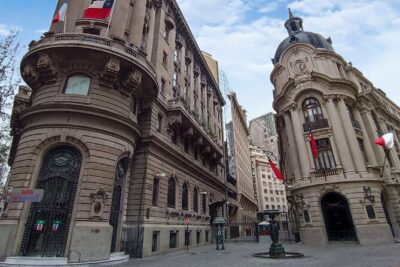
The route then moves through Santiago’s financial district. The Santiago Stock Exchange was founded in 1893 and operates from an elegant French-style building. Its architecture reflects the city’s late 19th and early 20th-century economic ambitions, when Chile was building stronger links with overseas markets.
You may also pass the former National Congress building, a grand 19th-century neoclassical structure surrounded by gardens. It connects the financial and political parts of the city, showing how close Santiago’s government institutions and commercial center sit to one another.
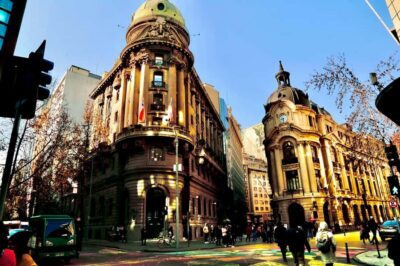
Paseo Nueva York provides one of the route’s most unusual changes of mood. This short street has early 20th-century neoclassical buildings and an atmosphere inspired by the international city Santiago hoped to resemble during its period of modernization. It is quieter than the main downtown streets and makes a good five-minute photo stop.
I like this section because it avoids presenting Santiago as only colonial or only modern. In a few blocks, you see the city’s republican architecture, financial confidence, and taste for European and American models.
San Francisco Church and Barrio París-Londres
The Church of San Francisco dates to 1618 and is described as the oldest standing building in Santiago. That age is significant in a city shaped by earthquakes and repeated rebuilding. The church gives you a direct look at the city’s Spanish colonial beginnings, along with religious art connected to that period.
The visit is brief, about five minutes, and entry depends on accessibility at the time. The tour includes entry into selected churches and historic landmarks when possible, but you should not assume every interior will be open for a full visit.
Next comes Barrio París-Londres, a small district with narrow, irregular streets and European-looking buildings. Its layout breaks from Santiago’s usual grid, and the neighborhood has been protected as a Zona Típica since 1982.
This is another short stop, but it is a useful reminder that downtown Santiago changes character from block to block. The neighborhood feels more intimate than the broad civic plazas, and its French and English street names reveal an earlier effort to give the capital an international polish.
Paseo Estado, St. Augustine, and Casa Colorada
Paseo Estado brings you back into the city’s commercial core. This pedestrian street is lined with shops, historic buildings, and everyday street activity. It is not treated as a formal monument, and that is part of its value. You get a look at how Santiago’s historic center functions as a lived-in downtown rather than a collection of preserved façades.
The Church of St. Augustine, built in the early 1600s, adds another old religious landmark. Its baroque design and the statue known as Cristo de Mayo connect the building to a famous earthquake tradition. The stop is short, but the church gives the guide another chance to explain how religion, art, and natural disasters have shaped Santiago’s identity.
Casa Colorada offers a secular contrast. Built in 1769, this red-fronted colonial mansion is among the best-preserved examples of its type in the city. It was linked to important figures in Chile’s independence movement, so the house helps tie domestic architecture to the political changes discussed at La Moneda.
These stops pass quickly. I would focus on listening to the guide’s explanation rather than trying to inspect every detail. If a particular church or historic house interests you, note it down for a later, slower visit.
Plaza de Armas and the Metropolitan Cathedral
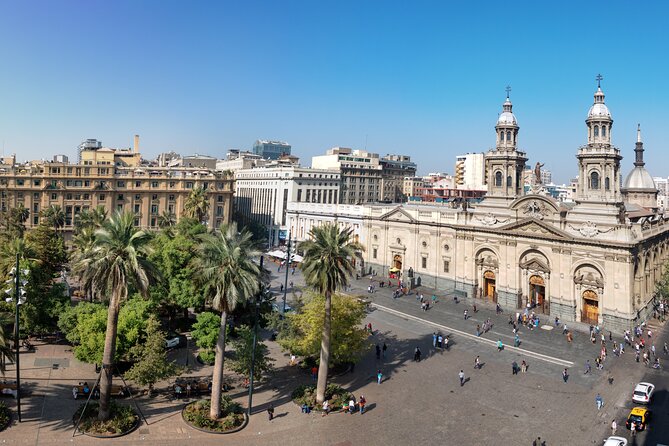
Plaza de Armas is Santiago’s historic center. The city was founded here in 1541, and the square remains one of the best places to watch the capital at work. You will find people sitting, walking, performing, and passing through, along with major civic and religious buildings around the edges.
The tour allows about 10 minutes in the plaza, more than at most earlier stops. That gives you time to take in the scale of the square and notice the blend of old architecture and present-day city life.
The Metropolitan Cathedral of Santiago sits on the plaza and serves as the seat of the Catholic Church in Chile. Built over the 18th and 19th centuries, it has a neoclassical exterior and a richly decorated interior. If the church is accessible during your visit, the guide can lead you inside as part of the included historic sightseeing.
I find this pairing particularly effective. The plaza represents public life, commerce, and civic gathering, while the cathedral represents the religious institution that has shaped Chile for centuries. Together they explain why Plaza de Armas remains central to any first visit to Santiago.
The former Congress and the National Museum of Fine Arts
The route also takes in two major institutions, the former National Congress and the Museo Nacional de Bellas Artes. The former Congress building is a strong example of republican-era architecture, with formal gardens that give it a more measured feel than the surrounding downtown streets.
The Museo Nacional de Bellas Artes occupies a Beaux-Arts building dating from 1910. Its collection is among the oldest art collections in Latin America and includes Chilean and international works. The tour provides an exterior or orientation view rather than a full museum visit, so treat this as a useful introduction for planning a return.
These stops help broaden the tour beyond independence monuments and churches. Santiago’s story also includes government institutions, public art, and the cultural ambitions of a growing capital.
Climbing Santa Lucía Hill to Neptune’s Terrace
The final major stop is Cerro Santa Lucía, a former rocky outcrop transformed into an urban park. Santiago was officially founded here in 1541, so the hill carries both geographic and civic importance.
The park has stairways, fountains, and elevated viewpoints. The tour allows about 20 minutes, enough to climb through part of the grounds and reach the area around Neptune’s Terrace. From there, you get panoramic views across central Santiago.
The finish works well. After two and a half hours of buildings, plazas, and street-level detail, the hill gives you a broader sense of how the city fits together. It also gives you a practical chance to pause before continuing on your own.
The tour ends in front of Neptune’s Terrace, with access to several forms of public transportation. Since the tour does not return to the starting monument, plan your next stop from Santa Lucía rather than assuming you will end near La Moneda.
What the $39 price really buys you
At $39 per person, this is not the cheapest way to walk around downtown Santiago. You can visit many of these public spaces on your own for no admission fee. The price makes sense because the guide links them into one clear story and secures a first-row position for the Changing of the Guard.
The small group improves the value. With a maximum of 10 people, you should have a better chance to hear the explanation, ask questions, and keep up without the stop-and-start feel of a large group.
The price is less attractive if you already know central Santiago well or mainly want independent time inside churches and museums. It is a good buy for a first visit, especially if you want the ceremony but also want context for the buildings around it.
Pace, comfort, and who should book
Most people can participate, and the tour is near public transportation. Service animals are allowed. Still, this is a walking tour with a steady sequence of stops, so comfortable shoes are sensible.
The route suits you best if you want a strong first orientation to Santiago’s center. It is also useful for history-minded visitors who prefer a guide to connect architecture, independence, government, religion, and city life.
I would be more cautious if you dislike group schedules or need long breaks. Several stops last only five minutes, and the tour covers many landmarks in one morning. Families and independent sightseers can enjoy it, but anyone seeking a slow architectural study should plan separate return visits.
Free cancellation is available until 24 hours before the 9:30 a.m. start time. Changes or cancellations inside that window are not accepted for a refund.
Should you book this Santiago walking tour?
Book it if you want La Moneda’s Changing of the Guard to anchor a wider introduction to Santiago. The first-row viewing spot, small group, English-language option, and Santa Lucía Hill finish give the morning a clear shape and solid value.
I would especially recommend it for a first day in the city, when you want to learn the downtown layout before exploring on your own. Emmanuel’s thoughtful approach and Ignacia’s enthusiasm suggest that the guide can make a real difference, so ask questions and use the walk to identify places you want to revisit.
Skip it if you want extended museum time, a slow café break, or a tour focused on one neighborhood. For everyone else, $39 buys a well-packed introduction to Santiago’s civic center, colonial core, and historic viewpoints.
FAQ
How long does the La Moneda and Santiago walking tour last?
The tour lasts approximately 2 hours and 30 minutes.
What time does the tour start?
The tour starts at 9:30 a.m.
Where does the tour begin?
It begins at the Monument to General Bernardo O’Higgins Riquelme on Avenida Libertador Bernardo O’Higgins in Santiago.
Where does the tour end?
It ends at Santa Lucía Hill in front of Neptune’s Terrace, with access to multiple transportation options.
Is the Changing of the Guard included?
Yes. The tour includes a first-row view of the Changing of the Guard ceremony at La Moneda Palace.
What languages are available?
The certified local guide service is offered in English, Portuguese, and Spanish. The tour listing specifically identifies English as an available option.
How large is the tour group?
The maximum group size is 10 people. Arrangements can be made for parties of 10 or more to maintain the same level of attention.
Can I cancel for a full refund?
Yes. You can cancel at least 24 hours before the experience start time for a full refund. Cancellations or changes made less than 24 hours in advance are not accepted for a refund.
Just added in Santiago
- Walking City Tour with Funicular, Cable Car and Tasting★ 4.3 · 6 reviews
- VIÑA DEL MAR AND VALPARAISO TOUR★ 4.8 · 20 reviews
- Tour VIÑA CONCHA Y TORO + CASA MARQUES – Chile, from Santiago.★ 5.0 · 2 reviews
- Undurraga + Isla Negra + San Afonso del Mar —– Full day★ 4.1 · 8 reviews
- Undurraga Wine tour★ 4.2 · 15 reviews
- Southcoast – Private Full-Day tour★ 5.0 · 6 reviews
- Santiago Private walking tour with Lunch★ 5.0 · 5 reviews
- Zapallar : nature, sea and local flavours★ 5.0 · 6 reviews
Walking Tours, compared.

Walk with Penguins on Magdalena & Marta Island
Read our review →
Santiago Half-Day Walking Tour with Hotel Pick up & Food Sample
Read our review →
A Fabulous Walking tour by the Old Santiago of Chile –
Read our review →
Santiago Half-Day Walking Tour with Hotel Pick up & Brunch
Read our review →
Santiago Skyline: Cable Car & San Cristobal Walking Tour
Read our review →Browse the lists this tour appears in