
REVIEW · FULL-DAY
From San Pedro de Atacama: The Salt Flats Route, Full Day
The high plateau makes a grand first impression. This six-hour shared excursion packs Salar de Atacama views, flamingo lagoons, Pakana rock formations, and the 5,916-meter Licancábur volcano into one morning. I like the shorter schedule, which gives you extra sleep compared with longer salt-lagoon outings, and I like the mix of wildlife and strange volcanic stone. The main drawback is simple but important: there are no toilets along the route, and the meeting-point directions have caused at least one serious problem.
The tour costs $78 per person and includes pickup, shared transport, a Spanish and English-speaking guide, breakfast, and a snack. I would consider that a fair price for a remote high-altitude outing, though entrance fees, meals, and drinks not listed in the package cost extra. Cold wind, thin air, and a long stretch without facilities mean you should prepare as carefully as you plan your camera shots.
In This Review
- Key Things to Know Before You Go
- Leaving San Pedro for Paso de Jama
- The First View: Salar de Atacama and San Pedro
- Licancábur at 5,916 Meters
- Birds and Small High-Altitude Lakes
- The Pakana Hills and Farellón de Tara
- Moai de Tara, the Pakana Witness
- The Pakana Cathedrals and Salar de Tara
- Breakfast, Snacks, and What to Pack
- Guide Quality and Meeting Point Care
- Is $78 a Fair Price?
- Who Should Book This Salt Flats Route?
- Should You Book It?
- FAQ
- How long does the Salt Flats Route tour last?
- What languages does the guide speak?
- What is included in the tour price?
- Are entrance fees included?
- How high does the tour go?
- Are there toilets along the route?
Key Things to Know Before You Go
- The route reaches about 4,500 meters: Salar de Tara sits much higher than San Pedro de Atacama, so the altitude is a real part of the experience.
- Licancábur is the visual anchor: At 5,916 meters, the volcano gives the route one of its clearest and most memorable views.
- Pakana has unusual volcanic formations: Farellón de Tara, the Moai de Tara, and the Pakana Cathedrals look unlike the salt flats themselves.
- Flamingos and other birds appear along the way: Small high-altitude lakes provide habitat for flamingos and other birdlife.
- Breakfast begins the outing: A decent breakfast is included, but bring extra water and food if you need more than a snack.
- Meeting details matter: Confirm the exact pickup point before departure, then arrive early. One booking failed because the meeting instructions were too vague.
Leaving San Pedro for Paso de Jama
The day begins at 8:00 a.m. in San Pedro de Atacama, heading toward Paso de Jama and the Chilean border-control area. You travel on the international route, where the road climbs steadily through volcanic ground formed by lava and ash.
That steady climb is not just a way to reach the next stop. It changes the feel of the morning. San Pedro sits in a desert basin, while the route quickly moves toward broad highland country with colder air, rough volcanic slopes, and much less human development. I like this gradual change because you can see the terrain shift rather than simply being dropped at a far-off viewpoint.
The transport is shared, so this is not a private, flexible road trip. The upside is a lower price and a social, guided format. The tradeoff is that the pace and stops are set by the group. The supplied information does not specify the vehicle size, so I would not book this expecting a private car or a custom itinerary.
The route heads toward Chilean border control, but this is presented as part of the road rather than as a separate border-crossing excursion. Bring your passport or required travel documents if your operator instructs you to do so, but do not assume that border procedures are the central attraction. The main purpose is reaching the high plateau and its salt formations.
More things to do in San Pedro de Atacama:
- San Pedro de Atacama: El Tatio Geysers Tour
★ 4.7 · 943 reviews - Tour to the Hidden Lagoons of Baltinache
★ 5.0 · 694 reviews - San Pedro de Atacama: Etno-Stargazing Tour with Transfer
★ 4.8 · 629 reviews
The First View: Salar de Atacama and San Pedro
One early stop gives you a panoramic view of the Salar de Atacama and the Oasis of San Pedro de Atacama. This is a useful orientation point. From above, you can connect the town, its green oasis, and the enormous salt basin that defines the area.
The Salar de Atacama is not just a pretty white patch. It helps explain why San Pedro has such stark contrasts: cultivated greenery around the oasis, dry salt country beyond it, and high volcanoes framing the horizon. The view is particularly valuable early in the trip because it shows how far you are climbing and how broad the region really is.
Do not expect this to be the same experience as spending hours at a salt lagoon. Here, the salar is part of a wider route. You get a scenic overlook and then continue toward the mountains, wildlife, and formations near Salar de Tara.
The high plateau can be cold, even when San Pedro feels warm. One confirmed experience described cold winds, so pack layers rather than relying on the morning temperature in town. A hat, warm jacket, and clothing that blocks wind will make the photo stops much more pleasant.
Licancábur at 5,916 Meters
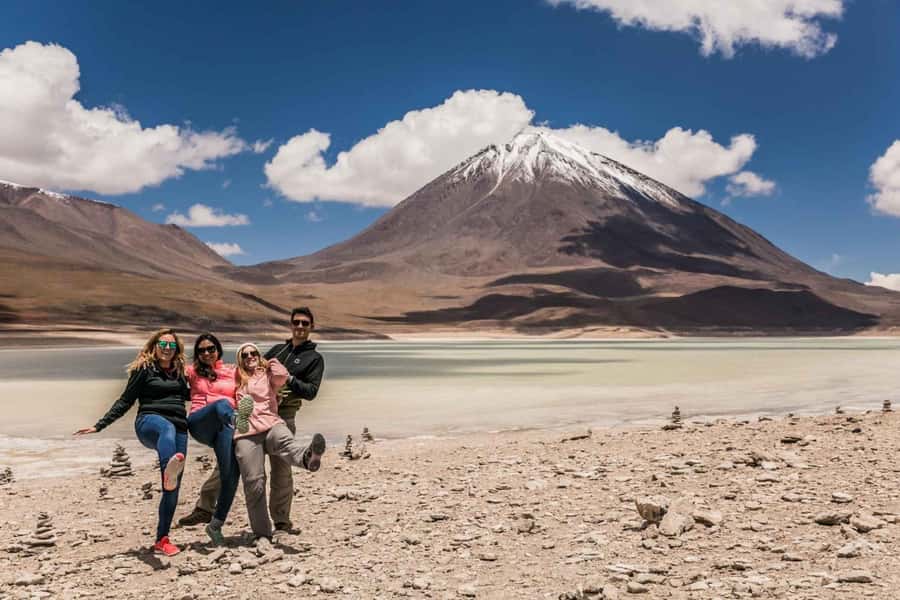
At about kilometer 41, the road reaches an altitude of roughly 4,200 meters. A detour toward Hito Cajón Norte and Licancábur provides a view of the volcano, whose summit rises to 5,916 meters.
Licancábur is one of the clearest symbols of this part of Chile. Its shape gives the otherwise open high plateau a strong focal point, and the height helps you understand the scale of the Andes. You are not climbing the volcano on this trip. You are viewing it from the route, which makes this an accessible way to appreciate one of the region’s great peaks without a mountaineering itinerary.
Altitude deserves more attention than it often gets in tour descriptions. The route reaches 4,200 meters before continuing higher, and Salar de Tara sits at about 4,500 meters. You might notice the thin air through shortness of breath, a headache, or simply a slower pace when walking around the stops.
Keep your movements calm and follow your guide’s instructions. The tour is only six hours, but the altitude can make a short stop feel more demanding than it looks on paper. If you already know that high altitude affects you strongly, this is a point to weigh before booking.
Birds and Small High-Altitude Lakes
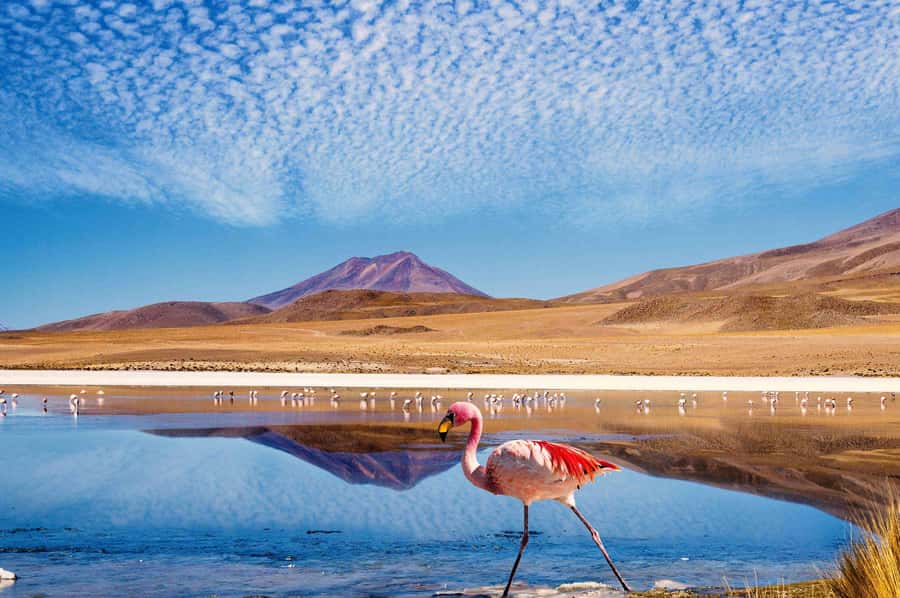
Around kilometer 75, the route passes small lakes where flamingos and other birds live. These water pockets are a fine contrast to the dry rock and salt. They also show why the high plateau is more than empty desert.
Flamingos are the most notable birds listed for this trip, including Chilean flamingos at Salar de Tara. You may also see groups of ostriches along the route. The information does not promise exact wildlife sightings, so bring patience and binoculars if you have them. Wildlife is never a timed performance, particularly in a broad, exposed area.
The bird stops may appeal most to people who want more than geology. You get volcanic scenery, salt formations, and a chance to look for living things adapted to a difficult environment. For a short tour, that variety gives the day more substance.
Still, the viewing conditions may be basic. This is not described as a birding tour with hides, long observation periods, or specialist equipment. Your guide will help point out what is present, but you should think of wildlife as one part of the route rather than its sole purpose.
A completely different kind of day out:
- Piedras Rojas, Altiplanics Lagoons & Salar Full-Day Tour
★ 4.7 · 592 reviews - The Roofless Experience San Pedro de Atacama Stargazing Tour
★ 5.0 · 522 reviews - Half Day Tour to Geysers del Tatio
★ 5.0 · 499 reviews - San Pedro de Atacama: Stargazing Experience
★ 4.7 · 489 reviews
The Pakana Hills and Farellón de Tara
At about kilometer 91, the route passes through the Pakana hills before going around the Farellón de Tara. Farellón de Tara is described as a rock wall carved into sculptural forms by geological forces.
This section gives the day a different visual rhythm. The salt flats and lakes are broad and low, while the Pakana formations rise as sharp, weathered stone shapes. I like this change because you are not seeing the same kind of desert view repeatedly. The rock formations make the route feel like a collection of distinct natural rooms.
The wording used for the formations can sound almost architectural, but the appeal is geological. Wind, volcanic activity, and time have shaped the stone into forms that can look deliberately built. Your guide may explain the setting in Spanish or English, which adds useful context to what you are seeing.
Because this route is high and exposed, the weather can affect how comfortable the stop feels. The cold wind mentioned in the feedback is worth taking seriously here. Gloves or a warm layer can matter more than an extra camera lens.
Moai de Tara, the Pakana Witness
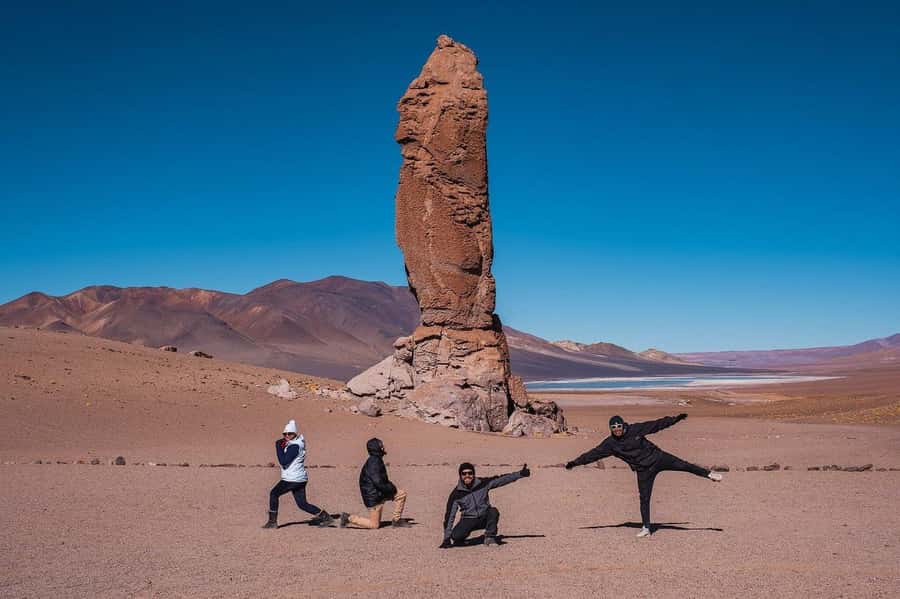
A little farther on, an open area contains the Moai de Tara, also called the Pakana Witness. These are groups of column-like rock structures preserved from geological periods when major volcanic events shaped the region.
The name Moai de Tara invites a comparison with the famous statues of Rapa Nui, but you should not expect carved human figures. The attraction is the natural arrangement of tall stone columns and the way they appear across the open ground. Their forms are a reminder that the high plateau has been shaped by powerful volcanic forces over immense spans of time.
This is one of the more distinctive stops because it gives you something to interpret, not just photograph. Look closely at the shapes, the gaps between the columns, and the surrounding emptiness. The setting does much of the work.
There is no indication of a visitor center, restroom, or formal infrastructure at this stop. Treat it as a remote roadside visit. Stay near the group, listen for instructions, and remember that the environment is both fragile and physically demanding.
The Pakana Cathedrals and Salar de Tara
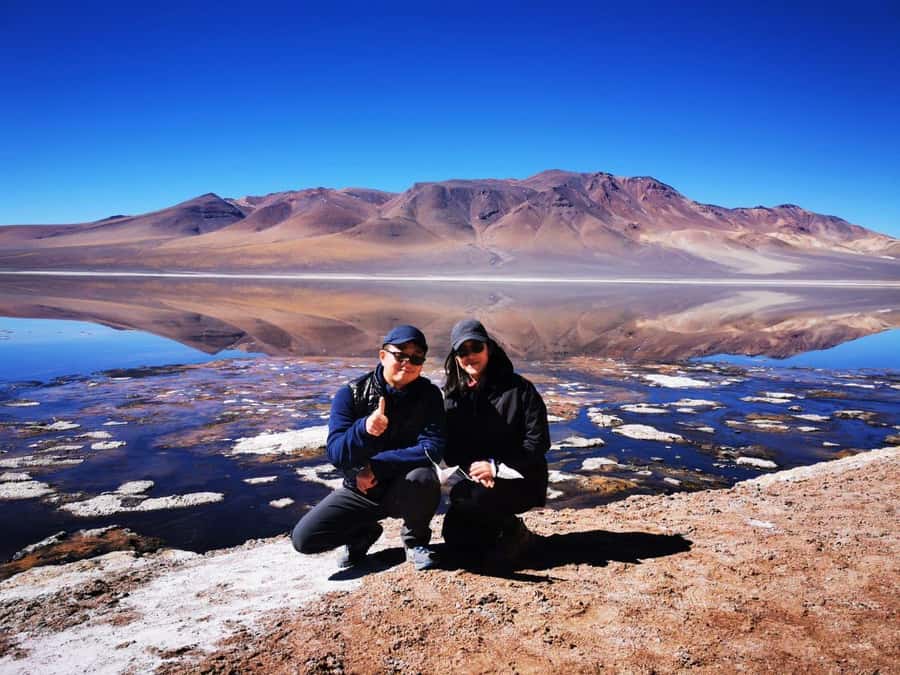
The route then reaches a panoramic view of the Pakana Cathedrals before arriving at Salar de Tara, about 4,500 meters above sea level. The Cathedrals are another set of dramatic rock formations, with the name referring to their towering, church-like shapes.
This is likely the visual high point of the outing. You have the stark salt lake, high mountains, unusual rock structures, and the possibility of flamingos in one setting. The scene feels broad and quiet, with the kind of scale that is hard to capture in a phone photograph.
Salar de Tara also matters as an ecosystem. The salt lake provides conditions that support birds in an otherwise harsh region. Chilean flamingos are specifically associated with the area, and the combination of salt, water, altitude, and wildlife gives the stop more meaning than a simple scenic overlook.
The route description calls this a wonderful setting, but the experience will depend on weather, visibility, bird activity, and how your group handles the altitude. Do not judge the stop only by whether every flamingo is close or every mountain is clear. The appeal is the full setting, not one guaranteed photograph.
Breakfast, Snacks, and What to Pack
Breakfast is included at the beginning of the trip, and one confirmed outing described it as decent. A snack is also included. That is helpful for an early departure, but the package does not include unspecified meals or drinks.
I would bring extra water and a few simple snacks, especially because the route is remote and no full meal is promised. Do not assume that the included breakfast and snack will suit your appetite for a high-altitude morning.
Pack for cold wind even if San Pedro is sunny:
- Warm layers and a windproof outer jacket
- Water and any personal snacks you need
- Sunglasses and sun protection
- Comfortable shoes for short walks over uneven ground
- A camera or binoculars for birds and distant views
The biggest practical warning is the lack of toilets. There are no toilet facilities along the entire route according to the confirmed trip feedback. Plan accordingly before departure, and ask about the last available restroom when you meet the guide.
Guide Quality and Meeting Point Care
The tour includes a bilingual guide in Spanish and English. A guide named Marta received especially strong praise for making the stops enjoyable and helping the group get the most from each place. That matters on a route where geology, wildlife, and altitude all need explanation.
A good guide can also make the difference between simply seeing a rock formation and understanding why it looks the way it does. The listed stops have unusual names and geological stories, so the bilingual commentary is a real part of the value.
The weak point is the meeting-point information. One person arrived 30 minutes before departure but could not find the exact meeting place because the directions were too unclear, and missed the tour. Take this seriously. Confirm the pickup location directly before the day of departure and arrive early enough to sort out any confusion.
The experience includes pickup, but the supplied details do not state the exact pickup area, vehicle type, or group size. Ask those questions when booking if they affect your decision.
Is $78 a Fair Price?
At $78 per person, this tour is priced as a reasonably accessible way to reach a remote part of the high plateau. You get shared transport, a bilingual guide, breakfast, and a snack, while the route covers several major sights rather than one single viewpoint.
The value is strongest if you want variety in a short window. In about six hours, you can see the Salar de Atacama from above, look for flamingos and other birds, view Licancábur, and visit several Pakana formations before reaching Salar de Tara.
The price is less attractive if you want a private experience, a leisurely photography schedule, or included meals and entrance costs. Since entrance fees are excluded and the route is shared, check the final total and the exact inclusions before paying.
The tour has an overall rating of 3.7 from three reviews, with very different experiences reflected in the scores. That spread tells me the scenery and guiding can be excellent, but the practical side, especially meeting instructions and facilities, deserves your attention.
Who Should Book This Salt Flats Route?
I would recommend this experience to you if you want a shorter alternative to a full-day highland outing and prefer a mix of geology, birds, volcano views, and salt-lake scenery. It also suits people who would rather spend six focused hours on the route than commit to a longer day with an earlier start.
It may suit you particularly well if you are interested in unusual natural formations. Farellón de Tara, the Moai de Tara, and the Pakana Cathedrals make this more than a standard salt-flat visit.
Think twice if you need frequent restroom access, dislike cold wind, or are uncomfortable at 4,500 meters. It is also not the best choice if you expect a private vehicle, a flexible departure, or a guaranteed wildlife show.
Should You Book It?
Book this tour if you want a compact, scenic route into Chile’s high plateau and are prepared for cold, altitude, shared transport, and no toilets. The strongest reasons to go are the Licancábur view, the strange Pakana formations, and the chance to see flamingos around Salar de Tara.
Before booking, confirm the meeting point, ask about any entrance fees, and plan your water, clothing, and restroom stop. With those details handled, the $78 cost offers a solid way to see several remote sights without giving up an entire day.
FAQ
How long does the Salt Flats Route tour last?
The tour lasts six hours. Departure from San Pedro de Atacama is scheduled for 8:00 a.m.
What languages does the guide speak?
The live guide speaks Spanish and English.
What is included in the tour price?
The price includes pickup, shared transport, a bilingual guide, breakfast, and a snack.
Are entrance fees included?
No. Entrance fees are not included in the tour price.
How high does the tour go?
The route reaches about 4,200 meters near the Licancábur detour and about 4,500 meters at Salar de Tara.
Are there toilets along the route?
No toilets are available along the route, so plan to use facilities before departure.
Just added in San Pedro De Atacama
- Vallecito★ 4.7 · 13 reviews
- Atacama Desert and Magic Bus Visit★ 4.8 · 15 reviews
- San Pedro de Atacama: Valle de la luna★ 3.0 · 3 reviews
- Valle de la Luna: A Moon-Like Escape in Atacama★ 5.0 · 3 reviews
- Triple Tour: Piedras Rojas + Altiplanic Lagoons + Chaxa Lagoon★ 5.0 · 1 review
- Red Stones + Altiplánica Lagoons★ 5.0 · 1 review
- Atacama Stargazing Tour Under One of the World’s Clearest Skies★ 4.0 · 3 reviews
- Tour to Laguna Cejar and Tibenquinche★ 4.5 · 7 reviews
Full-Day, compared.
Small-Group Cajón del Maipo Full-Day Tour and Picnic
Read our review →
Piedras Rojas, Altiplanics Lagoons & Salar Full-Day Tour
Read our review →
Full Day Tour to Torres del Paine National Park
Read our review →
Full Day Tour to Piedras Rojas, Altiplanic Lagoons and Chaxa
Read our review →
Full day Vina del Mar and Valparaiso experience
Read our review →
Full-Day Tour Torres del Paine National Park from Puerto Natales
Read our review →
Browse the lists this tour appears in