
REVIEW · HISTORICAL TOURS
Santiago Changing of Guard and Historic Downtown Private Tour
Santiago’s story unfolds on foot. This three-hour private walking tour links the city’s major civic squares, colonial churches, old commercial streets, and Santa Lucia Hill in one well-planned route. I like the chance to see the Changing of the Guard at La Moneda and the mix of famous sights with less obvious corners such as Paseo Nueva York and Casa Colorada.
I also like the tour’s finish at Santa Lucia Hill, where the city opens up from above. The main consideration is pace: many stops are covered in about three hours, so several sites receive only a short explanation or exterior visit. The Changing of the Guard can also be canceled or altered because it is an official government ceremony.
In This Review
- Key points at a glance
- Why this Santiago walk works well
- La Moneda and the Changing of the Guard
- From the Stock Exchange to Paseo Nueva York
- San Francisco Church and Santiago’s oldest streets
- St. Augustine, Casa Colorada, and the colonial past
- Plaza de Armas and the Metropolitan Cathedral
- Political history beyond La Moneda
- Finishing at Santa Lucia Hill
- Is $69 a fair price?
- The guide can shape the experience
- Who should book this tour?
- FAQ
- How long does the Santiago walking tour last?
- What time does the tour begin?
- Where does the tour start?
- Where does the tour end?
- Is the Changing of the Guard included?
- Is this a private tour?
- What languages are available?
- Can I cancel for a full refund?
- Should you book it?
Key points at a glance
- A private route through central Santiago: Only your group takes part, which allows for a more personal walking experience than a large city tour.
- The Changing of the Guard at La Moneda: The colorful ceremony is the tour’s headline moment, though official events can affect the schedule.
- Old Santiago in layers: You move from Chile’s government center to colonial churches, neoclassical streets, plazas, and modern city life.
- A guide-led history lesson: The tour connects Santiago’s colonial beginnings, independence period, political past, and present-day identity.
- Santa Lucia Hill provides the finale: The route ends near Neptune’s Terrace, with panoramic views and access to several transport options.
- Good value for first-time visitors: At $69 per person, the tour covers a lot of ground without requiring separate entry fees at most stops.
Why this Santiago walk works well
Santiago can feel spread out at first. The city center has grand government buildings, older churches, pedestrian shopping streets, formal plazas, and green public spaces, but the connections between them are not always obvious. This tour gives you a usable framework for understanding central Santiago in a single morning.
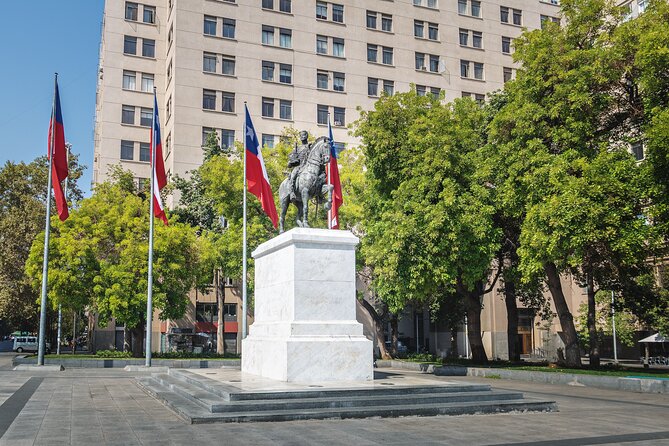
The route begins near the Monument to General Bernardo O’Higgins Riquelme on Avenida Libertador Bernardo O’Higgins. That is a practical starting point because the tour moves directly toward the government district rather than spending time on a long transfer.
You meet at 9:30 a.m., and the tour lasts about three hours. That timing matters. Santiago’s center is already active, but the morning route leaves much of the afternoon free for a museum, lunch, or a separate visit to another part of the city.
Because the activity is private, your group is the only group participating. That does not guarantee a slow or highly customized tour, especially with a full schedule, but it gives you a better chance to ask questions and adjust the explanation to your interests. The guides speak Portuguese, English, or Spanish.
More history tours in Santiago:
- Santiago: Guided Walking Tour of the Historical Old Town
★ 4.8 · 459 reviews - Tour Viña Santa Rita: History, Wine and Picnic Outdoors
★ 4.5 · 141 reviews - Viña Del Mar and Valparaiso world heritage site.
★ 4.5 · 89 reviews
La Moneda and the Changing of the Guard
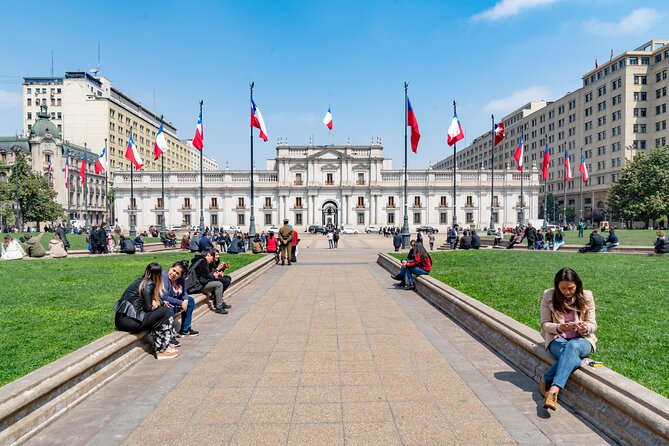
The first major stop is Plaza de la Ciudadanía, also called Citizenship Park. This broad civic space runs from the southern side of La Moneda Palace toward Avenida Libertador Bernardo O’Higgins. Its open design gives you a clear view of the government quarter and creates a useful introduction to Chile’s public life.
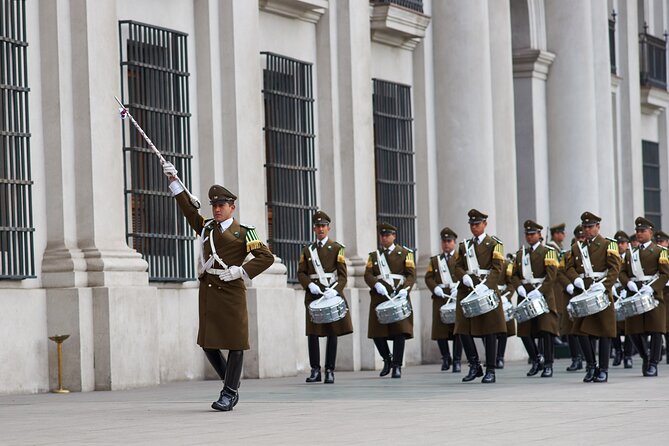
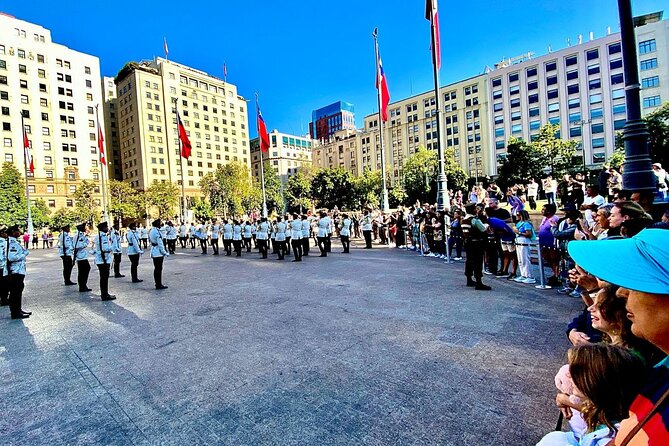
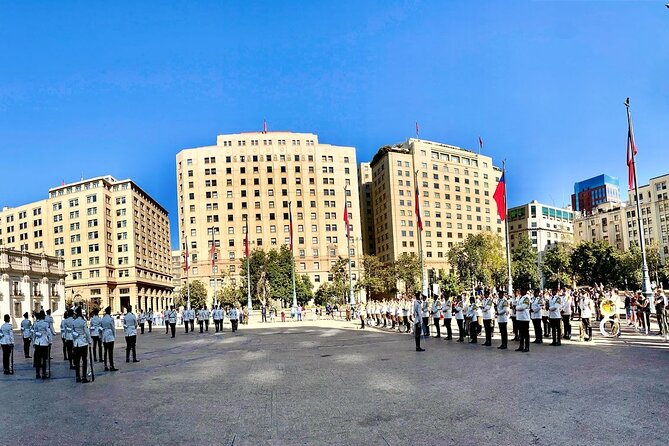
The tour then spends about 45 minutes around La Moneda Palace. La Moneda is Chile’s presidential headquarters and one of Santiago’s most important political buildings. The main event is the Changing of the Guard, a formal ceremony with uniforms, music, and carefully ordered movements.
This is more than a quick photo opportunity. A good guide can explain why the ceremony matters, how La Moneda fits into Chilean government, and how the surrounding squares reflect the country’s political identity. The tour description also promises background on Chile’s evolution from colonial society to modern capital, so this is where the broad historical story begins to take shape.
There is one important warning. The ceremony is controlled by the government and may be changed or canceled without notice because of official events or special security protocols. You should treat it as a strong possibility, not an absolute guarantee. The activity information lists admission to La Moneda as not included, but the tour centers on viewing the public ceremony rather than promising a regular interior palace visit.
Constitution Square follows. This formal plaza is closely tied to La Moneda and Chile’s national government. The stop is short, about five minutes, so you will mainly receive orientation and historical context rather than a long visit.
From the Stock Exchange to Paseo Nueva York
After the government center, the walk shifts toward Santiago’s commercial and financial past. The Santiago Stock Exchange occupies a French-style building dating from the late 19th century, when Chile was experiencing major economic growth. Even if you are not interested in finance, the building helps explain the confidence and ambition visible in central Santiago’s older architecture.
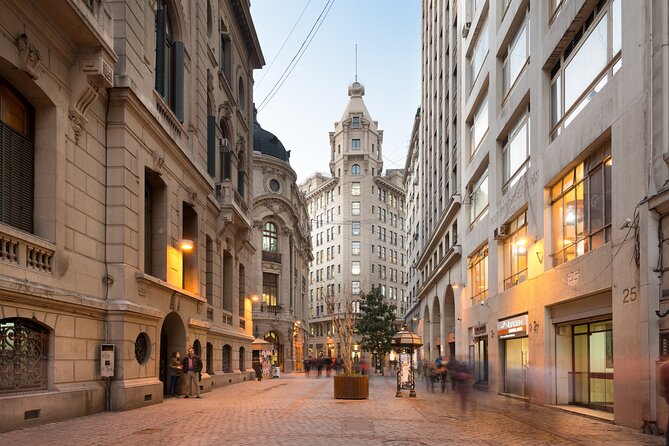
Paseo Nueva York is one of the route’s more entertaining discoveries. This short street has early 20th-century neoclassical buildings and a name that hints at Santiago’s wish to present itself as a modern international city. It feels different from the broad civic spaces around La Moneda. You get a compact architectural scene rather than another large square.
The stop is scheduled for about five minutes, which is enough for photos and a quick explanation. If you enjoy architecture, you may wish the tour allowed more time here. Still, the short pause works as part of the larger route because it shows how quickly Santiago’s character changes from government district to financial center.
San Francisco Church and Santiago’s oldest streets
The Church of San Francisco is one of the most valuable historical stops on the tour. Dating to 1618, it is described as the oldest standing building in Santiago. The church survived the earthquakes that have repeatedly reshaped the city, making it an unusually direct link to the colonial period.
The tour includes about five minutes at the church. That is not enough for a careful examination of every architectural detail or religious artwork, but the guide can point out why the building matters and give you a useful introduction before you look inside, if access is available.
The tour also passes along Paseo Estado, one of the city’s main pedestrian streets. This is where Santiago’s everyday commercial life comes into view. Shops, older buildings, pedestrians, and street activity create a lively contrast with the formal government quarter.
This transition is one of the tour’s strengths. You are not seeing isolated monuments one by one. You are watching the city change as you walk, from official Santiago to the shopping streets and public spaces used by residents.
More things to do in Santiago:
- Valparaiso Port and Viña del Mar with Casablanca Wine Tasting
★ 5.0 · 6,110 reviews - Santiago: Cajon del Maipo/Embalse del Yeso Tour with Picnic
★ 4.3 · 3,789 reviews - Santiago: Vina Del Mar, Valparaiso, Casablanca & Reñaca Tour
★ 4.2 · 2,838 reviews - Cable Car, Funicular and Sightseeing Bus in Santiago one day
★ 5.0 · 2,325 reviews
St. Augustine, Casa Colorada, and the colonial past
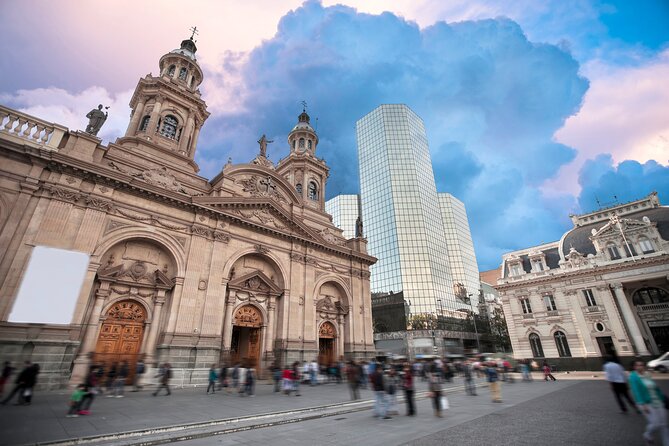
The Church of St. Augustine, also known as the Augustinians, dates from the early 1600s. Its baroque design and the famous Cristo de Mayo statue give the guide an opportunity to explain the role of religion in colonial Santiago. The statue is linked to a local earthquake tradition, a detail that makes the stop more memorable than a simple architectural description.
Again, the planned stop is brief. You should expect a concise explanation and perhaps entry when the church is accessible, rather than a long interior visit. Church access can depend on opening conditions and local activity.
Casa Colorada is another useful reminder that central Santiago still contains traces of the colonial city. Built in 1769, this red-fronted mansion is among the best-preserved colonial houses in the capital. It is associated with important figures from Chile’s independence period and gives the guide a natural point for discussing the years when Chile moved toward self-government.
The contrast between Casa Colorada and nearby commercial streets is worth noticing. Santiago is not preserved as a single old quarter. Instead, colonial houses and churches appear among offices, shops, traffic, and modern city buildings. That mixture is part of the city’s character.
Plaza de Armas and the Metropolitan Cathedral
Plaza de Armas is the historical heart of Santiago. The city was founded in 1541, and this square has served as its central public space for centuries. The stop lasts about ten minutes, enough to take in the scale of the plaza and watch its many forms of public life.
You may see street artists, performers, and people simply using the square as part of their daily routine. The point is not only to photograph the buildings around the plaza. It is to understand how Santiago’s oldest civic space still functions as a meeting point.
The Metropolitan Cathedral faces the plaza. Built between the 18th and 19th centuries, it is the principal Catholic church in Chile and an important example of neoclassical design. Its interior is more decorated than the outside suggests, so a visit when accessible adds useful variety to the walking route.
The cathedral stop is listed at about five minutes. That is enough to enter, look around, and hear the main historical points. If you want a quiet, detailed church visit, you should return later on your own. The tour is designed to give you a strong first look, not to replace a full museum-style visit.
Political history beyond La Moneda
The route also includes the former National Congress building, a 19th-century neoclassical structure surrounded by gardens. Its presence reinforces the tour’s attention to Chilean politics and institutions. Along with La Moneda and Constitution Square, it helps you see how much of central Santiago was shaped by government.
The building is a good reminder that the capital’s history is not limited to the colonial period. The tour moves across several centuries, from the founding of Santiago to the development of the republic and the city’s modern political role.
The Museo Nacional de Bellas Artes is another landmark on the route. It occupies a Beaux-Arts building from 1910 and houses one of Latin America’s oldest art collections. The tour does not present this as a full museum visit, so you should not expect time to explore the galleries in depth during the three-hour walk.
Still, seeing the building helps place Chilean art in its wider cultural setting. If the museum interests you, note its location and plan a separate visit after the tour.
Finishing at Santa Lucia Hill
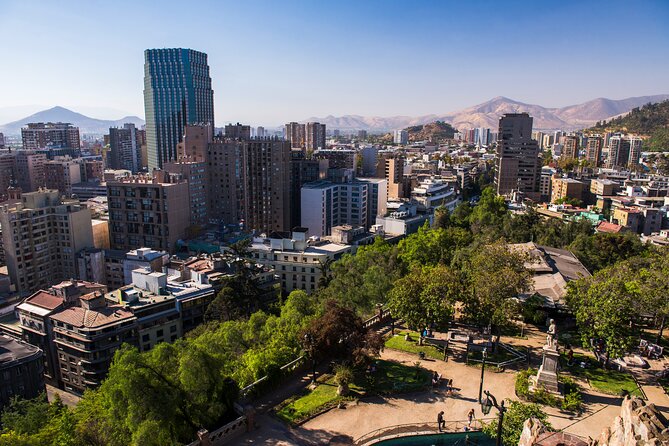
The final stop is Cerro Santa Lucia, or Santa Lucia Hill. This rocky rise was transformed into an urban park, with stairways, fountains, terraces, and views across Santiago. It is also the place where Santiago was officially founded in 1541, giving the tour a satisfying return to the city’s earliest chapter.
You spend about 20 minutes here. The route ends in front of Neptune’s Terrace, where you can enjoy panoramic views and choose from several transport options afterward. This is a practical finish because you are not left at an isolated meeting point.
Santa Lucia Hill gives the tour its best visual payoff. After walking through dense streets and enclosed churches, you can look back across the central city and connect the separate places you have just visited. The view also helps explain Santiago’s scale and setting.
The hill does involve stairs and an uphill walk. The tour information says most people can participate, but anyone who finds uneven paths or steps difficult should keep this section in mind. Service animals are allowed, and the route is near public transportation.
Is $69 a fair price?
At $69 per person, the tour is not the cheapest way to wander downtown Santiago. You can visit many public spaces independently and see the exteriors of several buildings without paying admission. The value comes from the private guide, the organized route, the ceremony timing, and the historical links between the stops.
You are also covering a lot in three hours. That can save you the work of planning a route through central Santiago, especially if you are visiting for the first time or want an introduction before exploring independently.
The price makes the most sense for a small group that values explanation and convenience. It is less compelling if you prefer to spend 20 minutes inside each church, browse the art museum, or move at your own pace. In that case, a self-guided day with separate museum visits may suit you better.
There are no advertised admission charges for most of the listed stops. The experience includes entry into select churches and historic landmarks when they are accessible, but it does not promise interior access everywhere. Bring your phone for mobile ticketing and wear shoes suitable for several hours of walking.
The guide can shape the experience
The tour depends heavily on the guide because so many stops are brief. You want someone who can explain the political, colonial, religious, and architectural threads without turning every corner into a lecture.
Ignacia has been specifically praised for being friendly and for clearly enjoying her work. If she leads your group, that warm approach could make the dense schedule feel more relaxed. Guides are available in English, Portuguese, and Spanish, so select the language that lets you ask questions comfortably.
I would also tell you to ask about the Changing of the Guard early in the tour, especially if the ceremony is your main reason for booking. Since the event can be canceled for government reasons, your guide is the right person to clarify what is happening that morning.
Who should book this tour?
I would recommend this experience to a first-time visitor who wants a clear introduction to central Santiago, especially anyone interested in government, colonial buildings, churches, and urban history. It also suits people who prefer a private guide and want to end near a useful transport point.
It works well for curious explorers who enjoy seeing how different parts of a city fit together. The walk moves from grand civic spaces to ordinary shopping streets, which gives you more than a string of postcard stops.
I would be more cautious if you dislike walking, need generous time at each site, or are mainly interested in art museums. The route is full, and most individual stops are short. The Changing of the Guard is an appealing extra, but it is not fully under the tour company’s control.
FAQ
How long does the Santiago walking tour last?
The experience lasts approximately three hours.
What time does the tour begin?
The tour begins at 9:30 a.m.
Where does the tour start?
It starts at the Monument to General Bernardo O’Higgins Riquelme on Avenida Libertador Bernardo O’Higgins, Santiago.
Where does the tour end?
It ends at Santa Lucia Hill in front of Neptune’s Terrace, with access to several transportation options.
Is the Changing of the Guard included?
Yes, the tour includes the Changing of the Guard parade at La Moneda Palace. The ceremony may be changed or canceled without notice because it is a government event.
Is this a private tour?
Yes. Only your group participates in the private activity.
What languages are available?
The certified local guide may conduct the tour in Portuguese, English, or Spanish.
Can I cancel for a full refund?
You can cancel at least 24 hours before the experience start time for a full refund. Cancellations or changes made less than 24 hours before the start time are not accepted for a refund.
Should you book it?
Book this tour if you want Santiago’s historic center explained in one efficient morning, with the added chance to see the Changing of the Guard and finish above the city at Santa Lucia Hill. At $69 per person, the strongest value comes from the private format and the guide’s ability to connect places that might otherwise feel unrelated.
Go in expecting a brisk overview rather than long visits inside every landmark. If that sounds right for your first day in Santiago, this is a practical and engaging choice.
Just added in Santiago
- Walking City Tour with Funicular, Cable Car and Tasting★ 4.3 · 6 reviews
- VIÑA DEL MAR AND VALPARAISO TOUR★ 4.8 · 20 reviews
- Tour VIÑA CONCHA Y TORO + CASA MARQUES – Chile, from Santiago.★ 5.0 · 2 reviews
- Undurraga + Isla Negra + San Afonso del Mar —– Full day★ 4.1 · 8 reviews
- Undurraga Wine tour★ 4.2 · 15 reviews
- Southcoast – Private Full-Day tour★ 5.0 · 6 reviews
- Santiago Private walking tour with Lunch★ 5.0 · 5 reviews
- Zapallar : nature, sea and local flavours★ 5.0 · 6 reviews
Historical Tours, compared.
Tour Viña Santa Rita: History, Wine and Picnic Outdoors
Read our review →
Elqui Valley Tour: History and Flavors (NOT FOR CRUISES)
Read our review →
Viña Del Mar and Valparaiso world heritage site.
Read our review →
Walking Tour Valparaiso, History & Art – Private Optional
Read our review →
Essence of Santiago : History, Flavors and Panoramic Views
Read our review →
2 Day Private Tour: Easter Island’s Cultural Heritage
Read our review →
Browse the lists this tour appears in