
REVIEW · SAN PEDRO DE ATACAMA TOURS
Private tour from San Pedro de Atacama Chile to the Salar de Uyuni
Mars-like deserts, flamingo-filled lagoons, and a salt flat that seems to run forever. This three-day private tour links San Pedro de Atacama with Bolivia’s most famous sights, crossing the Hito Cajones border and ending in Uyuni. I like the personal service and the fact that private transfers keep the trip more comfortable than a standard shared excursion. I also like the route itself, which packs the Green Lagoon, Red Lagoon, Sol de Mañana geysers, hot springs, Tunupa, and the Salar de Uyuni into one carefully arranged journey.
The main drawback is the pace. You cover a huge amount of ground in only three days, with long stretches in remote high-altitude terrain. The $2,300 price per person is also a serious commitment, although the private vehicle, border transfer, two nights of accommodation, and higher-end Tayka hotel network may make it worthwhile for travelers who value comfort and time.
In This Review
- Key points to know before booking
- Why this private route makes sense
- Day one: from San Pedro to the high Bolivian lagoons
- Green Lagoon and White Lagoon
- Dali Desert and Polques hot springs
- Sol de Mañana geysers and Red Lagoon
- Day two: flamingos, volcanic islands, and the first salt-flat views
- Isla del Pescado and the approach to Tunupa
- Entering the Salar de Uyuni
- Day three: Tahua, Incahuasi, Colchani, and Uyuni
- Colchani and the final transfer
- Comfort, drivers, and the real cost of $2,300
- Who should book this three-day crossing?
- Should you book it?
- FAQ
- Where does the tour begin?
- Where does the tour end?
- How long does the experience last?
- Is this a private tour?
- What major sights are included?
- Are entrance tickets included?
- What level of fitness is required?
- Can I cancel for a refund?
Key points to know before booking
- Private travel from San Pedro to Uyuni: Only your group takes part, with pickup from your San Pedro hotel and a private transfer to the Bolivian border.
- Three days of major Altiplano sights: You visit Green Lagoon, White Lagoon, Dali Desert, hot springs, geysers, Red Lagoon, several smaller lagoons, and the Salar de Uyuni.
- Two nights in Tayka hotels: The tour uses the Red de Hoteles Tayka, described as the best hotel network in the area.
- A demanding but rewarding route: Moderate physical fitness is required, and the schedule leaves little room for lingering at each stop.
- A practical one-way finish: The tour ends in Uyuni, with transport to your hotel, the airport, or the bus station.
- Strong service reputation: Professional drivers and a polished, personal approach are central strengths of the experience.
Why this private route makes sense
Most people who reach San Pedro de Atacama are tempted by the Salar de Uyuni. The problem is that the crossing is not a short side trip. Bolivia’s southwestern corner is vast, remote, and filled with rough roads, high passes, mineral lakes, and long empty stretches.
This tour works well because it treats the crossing as a complete journey rather than a simple transfer. You do not merely arrive at the salt flat and leave. You spend the first day moving through the Eduardo Avaroa Andean Fauna National Reserve, then reach the salt region on the second day, and finish with more cultural and geological sights before arriving in Uyuni.
I like the private format here. Your group controls the experience more than it would in a shared vehicle, and the company promises personalized VIP service. The tour also includes the transfer from San Pedro de Atacama to Hito Cajones, the border with Bolivia, which removes one of the more awkward parts of planning this route.
Still, you should know what private travel does not change. The roads remain long, the weather can affect the schedule, and the altitude is part of the experience. This is not a relaxed hotel-to-hotel holiday. It is an active expedition across stark, exposed terrain.
More things to do in San Pedro de Atacama:
- San Pedro de Atacama: El Tatio Geysers Tour
★ 4.7 · 943 reviews - Tour to the Hidden Lagoons of Baltinache
★ 5.0 · 694 reviews - San Pedro de Atacama: Etno-Stargazing Tour with Transfer
★ 4.8 · 629 reviews
Day one: from San Pedro to the high Bolivian lagoons
The trip begins with a 7:00 am pickup at your hotel in San Pedro de Atacama. The transfer to Hito Cajones takes about three hours, so your first morning is mainly about crossing toward Bolivia and reaching the remote part of the route.
Once you are on the Bolivian side, the scenery changes quickly. Licancabur provides a memorable early view, with desert terrain that can look almost Martian. This is a good reminder that the tour is not only about the final salt flat. The route gives you a full day of unusual volcanic and mineral scenery.
Green Lagoon and White Lagoon
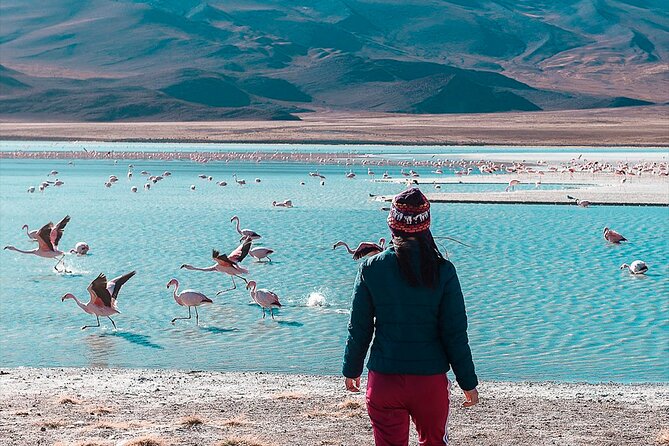
Laguna Verde, or Green Lagoon, gets its emerald color from minerals in the water. The shade can vary with conditions, but the setting is the real reward: an open high-altitude lake framed by stark desert and distant volcanic peaks.
You have about 30 minutes here, enough for photographs and a quick look around. Do not expect a long walk along the shore. The stop is short because the itinerary has many more sights ahead.
Nearby Laguna Blanca is milky rather than green. Its color comes mainly from borax and other minerals. The two lakes are separated by only a narrow strip of land, making them a natural pair on the route. You receive about 40 minutes for a visit and photographs.
I like this early section because the stops are close enough in theme to show how mineral content changes an entire body of water. It is also a useful point to take photographs before the day becomes more crowded with scheduled stops.
Dali Desert and Polques hot springs
The Salvador Dalí Desert has scattered rock formations and broad stretches of reddish-brown terrain. The name comes from the strange shapes and open composition, which can remind you of a surrealist painting.
The planned visit lasts about 40 minutes. You will spend much of that time looking rather than walking. This is a remote place, and its appeal comes from scale and isolation.
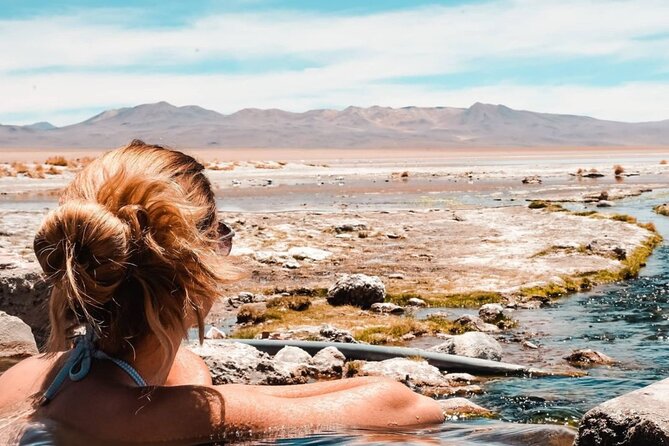
At Aguas Termales de Polques, you reach the Salar de Chalviri area, where white salt, red-brown desert, and blue water meet. You have about an hour, and admission is included. This is one of the few stops where you may have a chance to enjoy the setting at a slower pace.
The hot springs can be a welcome break after several hours in the vehicle. The tour information does not specify changing facilities or what you should bring, so pack practical clothing and do not rely on this stop as a full spa visit.
A few more options to weigh up in San Pedro de Atacama
- Full Atacama – SORBAC (private groups)
★ 5.0 · 76 reviews - Private Transfer to Calama Airport (CJC)
★ 5.0 · 5 reviews - Private Expeditions Laguna Lejía and Geyser Solitario
★ 5.0 · 4 reviews - San Pedro de Atacama: Private Dinner Under the Stars
★ 5.0 · 4 reviews
Sol de Mañana geysers and Red Lagoon
Sol de Mañana is the highest point of the route. Its vapors and geothermal activity are most dramatic in the morning, when the first rays of sunlight reach the area. The 40-minute stop gives you time to see the steaming ground and unusual colors.
You should follow the guide’s instructions closely around the geyser area. The tour description emphasizes rare vapors and active geothermal features, but it does not promise walkways or extensive safety infrastructure.
Laguna Colorada, the Red Lagoon, receives about an hour. Its reddish color comes from mineral content and the presence of tiny organisms, while flamingos add movement to an otherwise severe setting. The lagoon sits within the Eduardo Avaroa Andean Fauna National Reserve, a protected area with unusual plant and animal life.
The route then continues to Árbol de Piedra, the Stone Tree, a famous rock formation shaped by wind erosion. You get roughly 40 minutes here, with time for photographs and a short look at the surrounding Siloli Desert.
This portion of the day is visually powerful, but it is also tiring. By the time you reach the Stone Tree, you have already crossed several remote areas and stopped repeatedly for photographs. I would keep your expectations realistic: you are seeing many major sights, but you are not spending hours at each one.
Day two: flamingos, volcanic islands, and the first salt-flat views
The second day begins with Laguna Honda, a lake surrounded by high Andean terrain and wildlife. Flamingos, suris, and several kinds of ducks have been recorded in the area. The planned stop is about 30 minutes.
At Laguna Hedionda, you have around 40 minutes. The name means stinking lagoon, a reference to its mineral and sulfur content. The lake is particularly known for migratory pink and white flamingos, and its salt concentration is listed at 66 to 80 percent.
Laguna Cañapa follows, with another 40-minute stop. Pale salt deposits edge the water, while Andean plants surround the lake. These three lagoons make the morning feel less repetitive than you might expect. Each has a different color, shoreline, and animal life.
You should bring patience for the wildlife. The tour includes flamingo sightings, but animals are not arranged for photographs. Your view may depend on the season, weather, and where the birds are feeding.
Isla del Pescado and the approach to Tunupa
Isla del Pescado, or Fish Island, is a dark island rising from the white Salar de Uyuni. It formed from the remains of a petrified limestone volcano and contains tall cacti and smaller cactuses with large thorns.
The visit lasts about an hour. The contrast between black rock, white salt, and green cactus is one of the clearest visual symbols of the Salar. Admission is listed as free for this stop, while admission to Incahuasi Island on the following day is included.
The road then continues toward Tunupa Volcano. This section takes about three hours, making it one of the longest portions of the itinerary. You will see Andean flamingos and broad views over the salt flat while learning about local history and myths connected with the volcano.
The long drive is worth understanding before you book. Tunupa is not a quick roadside photo stop. It is a major part of the second day, and the time allows the route to reach the northern side of the Salar.
Entering the Salar de Uyuni
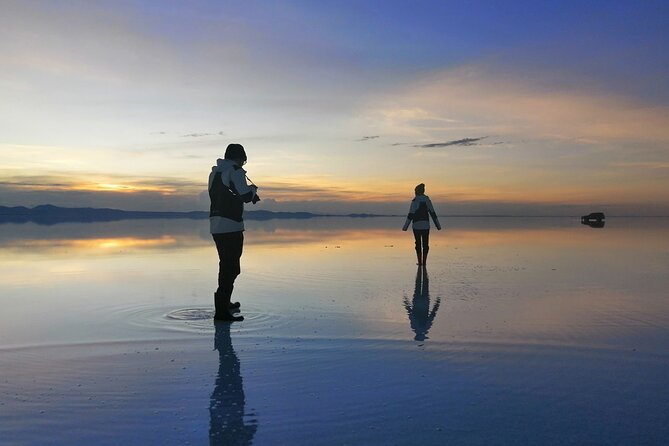
You spend about two hours on the Salar de Uyuni itself. At roughly 12,000 square kilometers, it is immense, bright, and difficult to judge by ordinary distances. The white surface can look like a giant glacier, especially when the horizon disappears.
The tour description calls this a walk of stars in the middle of the Salar. You should read that as a scenic experience under the open sky rather than a guaranteed astronomy program, since no telescope or formal stargazing service is specified.
The salt flat is the emotional high point for many people. I like that this tour reaches it after the lagoons and deserts, because you arrive with a stronger sense of how different the salt world is from the rest of the Altiplano.
Day three: Tahua, Incahuasi, Colchani, and Uyuni
The final day begins at Tahua, a village north of Tunupa at about 3,400 meters. The town is known for a cave containing the mummies of six people. You spend around an hour here.
This stop gives the trip a human and historical dimension after two days dominated by geology. The available information does not provide further detail about the mummies or the village visit, so you should view it as a short cultural stop rather than a full museum experience.
At Isla Incahuasi, you have about an hour. The island’s ground contains fossils of algae, mollusks, and other organisms known as stromatolites. Tall cacti rise from the rock, and the island provides views across the salt flat.
Admission is included at Incahuasi. The contrast with Isla del Pescado is useful: both are dark islands in the white salt, but the itinerary treats Incahuasi as an important final visit before the route moves toward the edge of the Salar.
Colchani and the final transfer
Colchani is a salt-working community of about 580 people. Local activities include salt extraction, agriculture, quinoa, crafts, and tourism. You spend about three hours in this area, making it one of the longest stops of the final day.
That extra time matters. Colchani is not just another photograph. It connects the enormous natural feature with daily work and local commerce. You can expect the focus to include salt, crafts, and the village’s role on the route to Uyuni.
The tour reaches Uyuni at approximately 6:30 pm. The team then takes you to your Uyuni hotel or arranges the onward transfer to Joya Andina Airport or the Uyuni bus station.
This one-way finish is a major practical advantage. You do not have to return to San Pedro, and you can use the tour as a bridge between Chile and the next stage of your Bolivian trip.
Comfort, drivers, and the real cost of $2,300
At $2,300 per person, this is not a budget Salar de Uyuni crossing. The value depends on what you would otherwise spend arranging privately: cross-border transport, drivers, accommodation, route planning, and transfers at the end.
The trip includes private transfers and a personalized VIP approach. It also uses the Red de Hoteles Tayka, described as the best hotel network in the area. Those details matter in a region where comfort options are limited and the distances are long.
The strongest service praise concerns the professional drivers. That is important here. A good driver is not only someone who gets you from one stop to the next. You need steady transport across remote terrain, punctual departures, and someone who understands the rhythm of a packed sightseeing day.
The price is easiest to justify if you are a couple, family, or small private group that values control and comfort. Group discounts may also be available, though the exact rate is not provided.
I would not choose this tour simply because it is the cheapest way to reach Uyuni. It is designed for people who want a private, organized crossing with a higher level of accommodation and less planning work.
Who should book this three-day crossing?
I would recommend it to you if you want to combine Chile’s Atacama region with Bolivia’s Salar without arranging separate transport. It suits photographers, first-time visitors to the Altiplano, and people who prefer private service over a shared vehicle.
It also suits anyone who wants a strong mix of scenery. You see colored lagoons, geysers, desert rock, hot springs, flamingos, salt, cactuses, a village, and a volcanic setting within three days.
You should think twice if you dislike early starts, long drives, rough remote routes, or repeated short stops. A moderate fitness level is required, and the itinerary offers little flexibility because so many sights are included.
Weather matters as well. If poor weather causes cancellation, you can choose another date or receive a full refund. For a full refund under normal cancellation terms, you must cancel at least 24 hours before the experience begins. Changes or cancellations made later are not accepted for a refund.
Should you book it?
Book this tour if you want a private, high-comfort route from San Pedro de Atacama to Uyuni and you value seeing the major Bolivian sights in one organized trip. The professional drivers, Tayka hotels, private border transfer, and one-way finish add real value.
Skip it if your main goal is the lowest possible price or a slow visit with plenty of free time. This is a fast, full itinerary across difficult terrain. For the right person, though, it is an efficient and memorable way to cross one of South America’s most unusual regions.
FAQ
Where does the tour begin?
The tour begins with pickup from your hotel in San Pedro de Atacama at approximately 7:00 am.
Where does the tour end?
The tour ends in Uyuni, Bolivia, at approximately 6:30 pm on the third day. Transport is provided to a Uyuni hotel, Joya Andina Airport, or the Uyuni bus station.
How long does the experience last?
The tour lasts approximately three days and includes two nights.
Is this a private tour?
Yes. Only your group participates in the private tour or activity.
What major sights are included?
The route includes Green Lagoon, White Lagoon, Dali Desert, Polques hot springs, Sol de Mañana geysers, Red Lagoon, Árbol de Piedra, Siloli Desert, several additional lagoons, Isla del Pescado, Tunupa, the Salar de Uyuni, Tahua, Isla Incahuasi, and Colchani.
Are entrance tickets included?
Some admissions are included, including the Polques hot springs, Sol de Mañana geysers, Siloli Desert, Laguna Hedionda, Laguna Cañapa, and Isla Incahuasi. Other stops are listed as free admission.
What level of fitness is required?
A moderate level of physical fitness is recommended.
Can I cancel for a refund?
Yes. You can cancel at least 24 hours before the start time for a full refund. If poor weather forces cancellation, you will be offered another date or a full refund.
Just added in San Pedro de Atacama
- Vallecito★ 4.7 · 13 reviews
- Atacama Desert and Magic Bus Visit★ 4.8 · 15 reviews
- San Pedro de Atacama: Valle de la luna★ 3.0 · 3 reviews
- Valle de la Luna: A Moon-Like Escape in Atacama★ 5.0 · 3 reviews
- Triple Tour: Piedras Rojas + Altiplanic Lagoons + Chaxa Lagoon★ 5.0 · 1 review
- Red Stones + Altiplánica Lagoons★ 5.0 · 1 review
- Atacama Stargazing Tour Under One of the World’s Clearest Skies★ 4.0 · 3 reviews
- Tour to Laguna Cejar and Tibenquinche★ 4.5 · 7 reviews
San Pedro de Atacama Tours, compared.

Piedras Rojas, Altiplanics Lagoons & Salar Full-Day Tour
Read our review →
The Roofless Experience San Pedro de Atacama Stargazing Tour
Read our review →
Full Day Tour to Piedras Rojas, Altiplanic Lagoons and Chaxa
Read our review →Browse the lists this tour appears in